

Key takeaway: Emotional intelligence is your ultimate career accelerator in the AI era! By mastering self-regulation and empathy, you don’t just resolve conflicts, you drive innovation and leadership. Professionals with high social mastery see faster promotions and significant salary growth, outperforming technical IQ. Start practicing cognitive restructuring today to boost your resilience and secure your long-term professional edge!
Professionals with high emotional mastery often see faster promotion cycles and significantly higher annual earnings than their peers. While technical skills might get you through the door, your ability to navigate the unspoken rules of corporate politics is what truly accelerates your trajectory. Many of us still struggle to manage high-pressure meetings without letting stress dictate our reactions.
I will show you how mastering emotional intelligence in the workplace protects your career against AI automation and boosts your leadership impact. Here’s how to put these strategies to work for your career.
Master Your Emotional Intelligence Workplace Edge
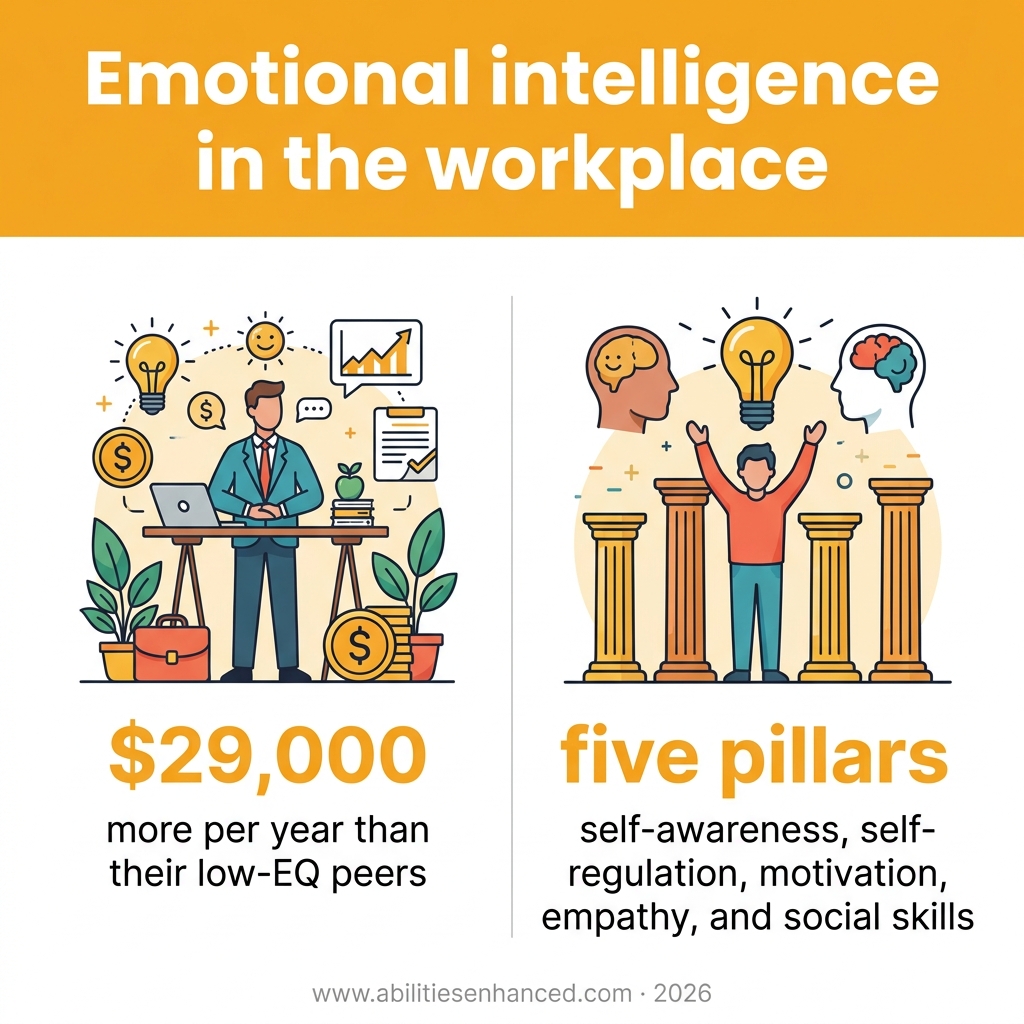
Emotional intelligence (EQ) hinges on five pillars: self-awareness, self-regulation, motivation, empathy, and social skills. These competencies drive leadership effectiveness and salary growth by outperforming technical IQ in conflict resolution and team collaboration.
These foundational pillars translate into very different skills on the job — here’s how each one shapes your professional trajectory.
The Five Pillars of Professional EQ
Self-awareness means recognizing your own triggers. Self-regulation is the ability to control impulsive reactions. These form the internal foundation of EQ.
Empathy allows you to understand colleagues’ perspectives. Social skills facilitate clear communication and influence. These external pillars manage professional relationships and daily office interactions.
Contrast these soft skills with technical expertise. Hard skills get you hired, but EQ ensures your long-term career growth.
Why Your EQ Outshines Your IQ
Modern employers prioritize interpersonal effectiveness over raw cognitive ability. Technical tasks are increasingly automated. Humans must provide the emotional glue that holds teams together. This shift makes social mastery a non-negotiable asset for any serious modern professional.
Executive roles require high emotional maturity to lead diverse groups. IQ alone cannot inspire loyalty or drive culture.
Career stability now depends on adaptability. High EQ professionals navigate layoffs and transitions with much greater resilience than peers.
Can High EQ Save You from AI Automation?
While technical skills face threats from software, the human heart remains irreplaceable in the corporate machine.
The Human Advantage in an Automated Office
AI lacks the ability to understand subtle emotional nuances. It cannot replicate genuine empathy during difficult conversations. This gap creates a massive competitive differentiator for humans.
Authentic human connection remains vital in client relations. Clients want to feel heard and valued by a person. Trust is built through shared emotions, not just processed data points.
Look at what technology simply cannot touch:
- Resolving deep-seated interpersonal grudges between team members.
- Providing nuanced ethical mentorship to junior colleagues.
- Sensing unspoken tension in a high-stakes boardroom meeting.
Turning Office Conflict into Productive Energy
Reactive behaviors damage team productivity and waste valuable resources. Instead, use responsive strategies to de-escalate tensions during high-pressure meetings. Pause before speaking to assess the room’s temperature. This deliberate calm transforms potential blowups into constructive debates.
Conflict resolution is directly linked to team performance. Healthy friction sparks innovation when managed with high EQ. Leaders must model this behavior to influence the overall company culture.
Unaddressed conflict drains energy. Mastery of these moments saves time and boosts collective output significantly. You have the power to turn friction into fuel!
3 Ways Emotional Awareness Boosts Your Salary
Managing your emotions doesn’t just feel better; it actually shows up in your bank account balance.
The Direct Link Between EQ and Career Advancement
Data shows a strong correlation between high EQ and annual earnings. Professionals with social mastery often see faster promotion cycles. They navigate the unspoken rules of corporate politics effectively.
| Skill Level | Avg. Salary Impact | Promotion Speed | Key Benefit |
|---|---|---|---|
| Low EQ | Baseline | Slow | Technical focus |
| Moderate EQ | +15% Growth | Average | Team stability |
| High EQ | +25% Premium | Accelerated | Strategic influence |
Effective mentorship and coaching require deep emotional awareness. Those who can develop others are viewed as high-value assets. This leadership capacity justifies higher compensation packages and bonuses.
Reducing Burnout Through Self-Regulation
Emotional monitoring prevents mental exhaustion by identifying stress early. You learn to set boundaries before reaching a breaking point. This internal regulation is the ultimate shield against burnout.
The Ability, Motivation, and Opportunity framework helps foster healthier organizational cultures. High job satisfaction stems from mastering internal emotional states. When you feel in control, work becomes a source of energy rather than a drain. This mindset is essential for longevity.
Happy employees are more productive. Mastering your mood is a professional skill that pays dividends in daily happiness.
Sharpen Your Social Cues for Remote Success
The challenge intensifies when the « room » you need to read is behind a digital screen.
Daily Exercises for Cognitive Restructuring
Practice cognitive restructuring by replacing unhelpful emotional responses with constructive ones. Identify a negative thought pattern. Challenge its validity and swap it for a proactive solution.
Use mindfulness techniques to improve professional focus. Even five minutes of breathing can reset your nervous system. This habit keeps you grounded during chaotic workdays or stressful deadlines.
Boost your emotional intelligence in the workplace by following these actionable steps:
- Ask for specific feedback.
- Listen without defending.
- Thank the provider.
- Implement one change immediately.
Reading the Room in Virtual Environments
Interpret non-verbal cues during video calls by watching facial micro-expressions. Tone of voice often reveals more than words in a remote setting. Pay attention to silences and pacing.
Active listening is critical for hybrid team communication. Summarize what you heard to ensure alignment. This prevents the misunderstandings that frequently plague digital workflows and remote projects.
Maintain rapport without physical presence through intentional check-ins. Small talk builds the social capital needed for difficult professional asks. Virtual EQ requires more deliberate effort than face-to-face interaction, but the rewards are identical.
The professionals who invest in these skills now will be the ones setting the tone in their organizations as automation reshapes more technical roles. Start with one habit — a daily check-in on your own triggers, or a slower pace in your next tense meeting — and build from there.
FAQ
What exactly is emotional intelligence in a professional setting?
Emotional intelligence, or EQ, is your ultimate superpower for the modern office! It is the dynamic ability to recognize, understand, and manage your own emotions while skillfully navigating the feelings of those around you. Unlike raw IQ, which focuses on logic, EQ centers on interpersonal mastery and constructive interactions.
According to the framework popularized by Daniel Goleman, professional EQ is built on five rock-solid pillars: self-awareness, self-regulation, motivation, empathy, and social skills. Mastering these allows you to transform every workplace interaction into an opportunity for growth and connection!
Can developing my EQ actually lead to a higher salary?
Absolutely! Investing in your emotional intelligence is one of the smartest financial moves you can make. Research shows a staggering correlation between high EQ and annual earnings, with high-EQ individuals earning an average of $29,000 more per year than their low-EQ peers. selon certaines estimations, l’amélioration du score d’intelligence émotionnelle peut être associée à une hausse de la rémunération annuelle|
Why does this happen? Because social mastery drives faster promotion cycles and helps you navigate the unspoken rules of corporate politics. Employers are desperate for leaders who can build trust and resolve conflicts, and they are willing to pay a premium for those who bring this « human glue » to their teams.
How does emotional intelligence protect my career from AI and automation?
While AI is fantastic at processing data and handling repetitive tasks, it completely lacks the human heart. High EQ is your irreplaceable edge in an automated world! Machines cannot replicate genuine empathy, nor can they sense the « unspoken » tension in a high-stakes boardroom meeting or provide nuanced ethical mentorship.
As technical tasks become increasingly automated, humans must step up to provide the emotional connection and complex problem-solving that software simply can’t touch. By doubling down on your social cues and relationship management, you ensure you remain a high-value asset that no algorithm can replace.
What are the best ways to improve my emotional intelligence at work?
The best news is that EQ is not fixed, it is a muscle you can build starting today! You can jumpstart your progress by keeping an emotional journal to track your triggers or by practicing mindfulness and cardiac coherence to stay grounded during stressful deadlines. These daily habits will sharpen your self-awareness and regulation instantly.
Don’t stop there! Actively seek out feedback and listen without getting defensive. Use proven tools like the DESC method for communication or « affect labeling » to name and tame your emotions. With consistent practice, you will transform your professional presence and lead with newfound confidence.
How can I show high EQ during virtual meetings and remote work?
Virtual EQ requires a bit more deliberate effort, but it pays off massively! Since screens can « flatten » our emotions, you should be slightly more expressive with your facial micro-expressions and use your hands as visual subtitles within the camera frame. Ensure your camera is at eye level to create a sense of direct contact and trust.
Active listening is your best friend in a remote setting. Always summarize what you have heard to ensure total alignment and prevent digital misunderstandings. Remember to value silence; ralentir légèrement votre débit de parole| and allowing pauses after questions helps everyone feel heard and reduces the frustration of audio lag.
Does high EQ help in preventing professional burnout?
Yes, it is your ultimate shield! High emotional awareness allows you to monitor your internal state and identify stress signals long before they turn into exhaustion. By mastering self-regulation, you learn to set healthy boundaries and manage your energy rather than just your time.
When you feel in control of your emotional responses, work becomes a source of energy instead of a drain. This internal regulation not only boosts your daily happiness but also ensures long-term career longevity. Happy, emotionally intelligent professionals are more resilient and productive, making burnout a thing of the past!
Commentaires récents