

Key takeaway: Transform vague ambitions into measurable SMART goals to skyrocket your career. Aligning personal growth with company KPIs and leveraging mentors—who can significantly increase your promotion odds—is your strategic advantage. Document every win with quantifiable data to prove your impact. Start your 30-60-90 day roadmap today and build the professional trajectory you deserve.
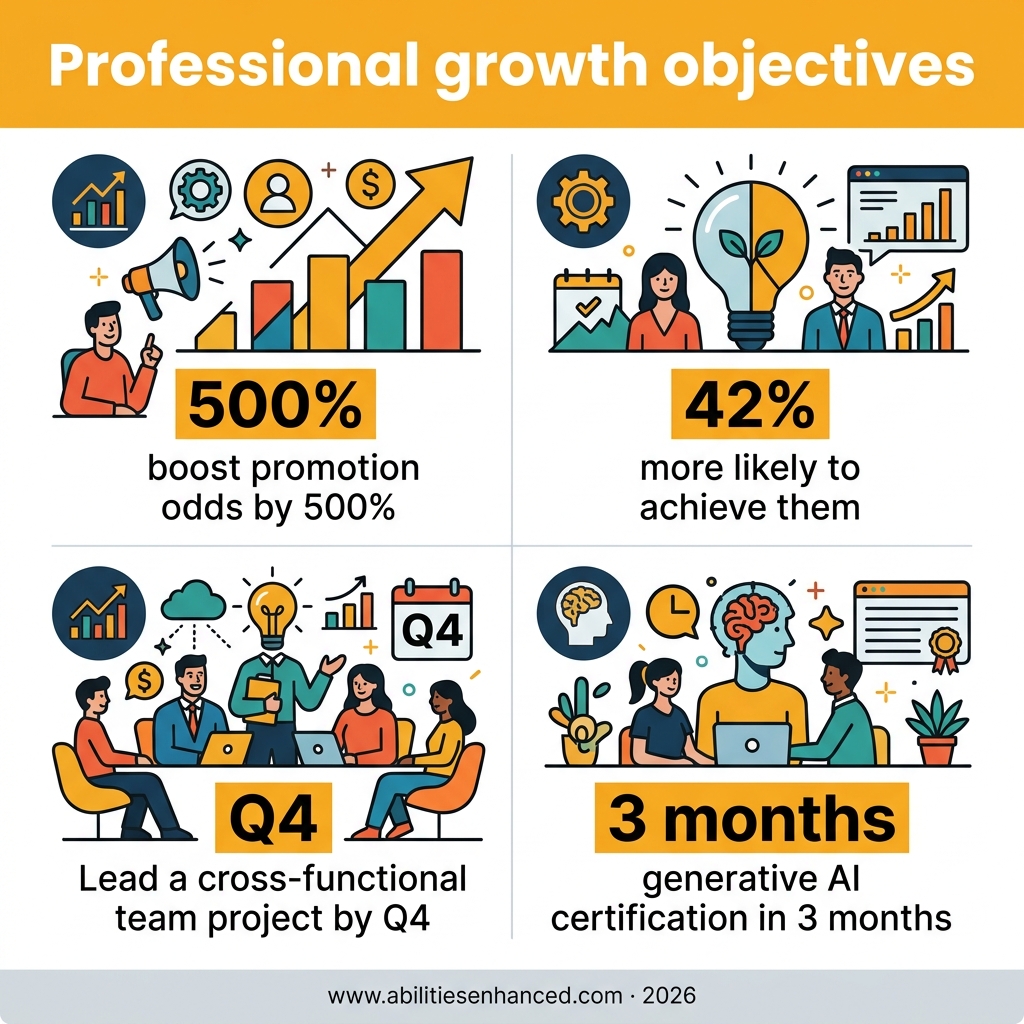
Writing down specific goals makes you 42% more likely to achieve them. Most professionals drift through their careers with vague aspirations, yet those who master their professional growth objectives transform their trajectory with surgical precision. The difference between stagnation and advancement lies in your ability to create a roadmap that converts ambition into measurable results.
I will show you how to bridge your skill gaps and align your ambition with organizational ROI to secure the promotions you deserve. We will break down the SMART framework together to ensure your next career move is both measurable and inevitable.
Master Your Professional Growth Objectives for Real Impact
Effective career growth requires the SMART framework to bridge skill gaps, aligning personal milestones with company ROI. Success hinges on documenting impact, leveraging sponsors for advocacy, and maintaining a 90-day execution roadmap to ensure measurable professional advancement.
Transitioning from vague intentions to a structured roadmap is the first step toward reclaiming your career trajectory and ensuring your hard work translates into visible progress.
Identify Your Current Developmental Gaps
Audit your current abilities against tough industry benchmarks today. Ignoring hidden weaknesses frequently stalls promotion cycles. Perform a rigorous skill gap analysis to reveal exactly where you stand.
Prioritize the specific deficiencies blocking your immediate progress. Professional stagnation carries a heavy financial and emotional cost. Decide right now which technical or soft skills require urgent repair to move forward.
These gaps create invisible roadblocks in your daily performance. Clarity in this phase dictates your entire growth strategy. The next step is to align these personal needs with your organization’s goals.
Connect Personal Ambition to Organizational Needs
Solo goals fail without company buy-in. Align your personal growth directly with the bottom line. Show leadership how your evolution solves a major manager headache or bottleneck.
Secure stakeholder support by proving your value. Demonstrate how your new certifications will drive higher revenue or operational efficiency for the team.
Focus on mutual value. Make the business case for your advancement undeniable and powerful.
Use this proven method to align your professional growth objectives with company success:
- Identify department KPIs to understand what leadership truly values.
- Map personal skills to these metrics to show direct correlation.
- Pitch the development plan as a solution to existing problems.
- Quantify expected ROI for the employer to justify the investment.
Build a Bulletproof SMART Goal Framework
Setting goals is easy, but making them stick requires a rigid framework that leaves no room for « trying » or « hoping. »
Quantify Soft Skills Like Leadership
Turn vague leadership aims into behavioral metrics. Don’t just « improve communication. » Instead, measure successful cross-departmental project completions or feedback scores.
Use feedback loops to track emotional intelligence. Set a target for specific interactions or conflict resolution outcomes. Data makes soft skills tangible.
Assign hard numbers to influence. Track how many of your proposals get greenlit. This proves leadership growth through results, not just feelings.
Set Realistic Timelines for Career Pivots
Break industry transitions into monthly phases. First month involves research and networking. Second month targets specific certifications. Third month focuses on application and brand repositioning.
Establish hard deadlines for technical skills. Urgency prevents the pivot from becoming a perpetual « someday » project. Keep the pressure manageable but constant.
Avoid professional burnout during the shift. Balance the hustle with realistic expectations of market timelines.
Avoid the Trap of Vague Aspirations
Kill the generic wishes. « I want to grow » means nothing to a recruiter. Define exactly what success looks like in black and white.
Eliminate ambiguity in your performance tracking. If you can’t report it in a spreadsheet, it isn’t a goal. It’s just a daydream.
| Vague Aspiration | SMART Objective | Key Metric |
|---|---|---|
| Become a leader | Lead a cross-functional team project by Q4 | 100% on-target delivery rate |
| Learn AI | Complete a generative AI certification in 3 months | Certificate of completion issued |
| Improve networking | Attend one industry event per month | 12 new LinkedIn connections annually |
| Get a raise | Secure a 15% salary increase by year-end | Signed contract with updated compensation |
Your professional growth objectives demand this level of precision. Stop guessing and start measuring.
Balance Quick Wins with Long-Term Career Legacy
While the SMART framework builds the engine, you need to decide if you’re racing for a lap or the whole season.
Focus on Immediate Upskilling and Reskilling
Target high-demand technical skills for instant utility. Learn the digital tools your team lacks today. Small wins build the confidence for larger leaps.
Implement rapid learning cycles. Don’t spend six months on a theory course. Get a certification that changes your workflow by next Monday.
Momentum is your best friend. Frequent, tiny skill acquisitions keep you relevant in a fast-moving market. Stay sharp, stay employed.
Map Out Promotions and Industry Transitions
Design a multi-year trajectory for executive roles. Identify the bridge roles needed to jump sectors. Think three steps ahead of your current title.
- Define the ultimate career peak.
- Identify 2-3 industries for potential pivots.
- List the authority markers needed (speaking, publishing).
- Schedule annual strategy audits.
Build sustainable authority. Don’t just chase titles; chase the legacy of the impact you leave behind.
Document Your Impact to Prove Readiness
Maintain a live record of achievements. Use quantifiable data to justify your next raise. If you didn’t write it down, it didn’t happen.
Create a portfolio that highlights future potential. Show how your past projects solve future problems. Data-backed proof beats a polished resume every time.
Use these records during performance reviews. Be the employee who brings receipts. Proof of readiness is a key factor for promotion, even though decisions also depend on context, internal politics, budget, and seniority.
Leverage Mentors and Sponsors to Accelerate Results
You can’t reach the top floor alone; you need people who have the keys and others who know the blueprint.
Distinguish Between Guidance and Advocacy
Mentors give advice; sponsors give opportunities. You need both to move fast. A mentor helps you grow, but a sponsor talks about you in closed rooms.
Understand the power dynamics. Mentoring is often a low-stakes relationship. Sponsorship requires you to deliver high-value results first. The sponsor puts their reputation on the line for you.
Leverage mentors for skill development. Use their experience to avoid common pitfalls. They are your sounding board for difficult career decisions.
Focus on building advocacy. Your work must be visible enough for a sponsor to feel confident backing you.
Conduct Productive Career Conversations with Managers
Frame your growth as a solution. Don’t ask for a course; explain how that course fixes a team bottleneck. Make it easy for them to say yes.
Ask for stretch assignments. These projects prove you can handle the next level. Use performance reviews to negotiate for specific resources and learning time. Be firm but collaborative.
Track the outcomes of these conversations. Follow up with progress reports. Show your manager that their investment in you is paying off.
Use these powerful conversation starters to align your ambition with organizational success:
- « How can my growth support our Q4 goals? »
- « What skill gap affects our output most right now? »
- « What specific impact would merit a promotion? »
Execute Your 30-60-90 Day Development Plan
Planning is just organized procrastination unless you put it into a strict, time-bound calendar.
Structure Your First Three Months of Growth
Day 1 to 30 is for learning. Identify the core competencies you need. Don’t try to execute before you understand the landscape.
Move to active implementation in month two. Apply your new skills to a live project. Test your theories in the real world.
Optimize by day ninety. Evaluate your performance and pivot where necessary. Results should be visible by now.
Use AI Tools to Boost Daily Productivity
Integrate automated workflows to save time. Use AI for rapid research and data synthesis. Free up your brain for high-level strategic thinking.
Employ digital assistants to track goal completion. Don’t rely on memory. Let technology handle the reminders and the progress charts.
Leverage technology for rapid skill acquisition. AI can summarize complex topics in seconds. Stay ahead of the curve.
Review and Adjust Your Trajectory Regularly
Schedule monthly audits of your progress. Be honest about your setbacks. A career pivot requires constant course correction.
Change strategies when the market shifts. Don’t stay loyal to a plan that no longer works. Maintain accountability through strict metrics and self-reflection. Your goals are not set in stone.
Reflection is not a luxury. It is a requirement for long-term success. Stay agile and stay focused.
Protect Your Progress From Burnout and Stagnation
The fastest way to kill a career is to redline your engine until it explodes; sustainability is the secret to winning.
Integrate Growth with Work-Life Harmony
Set boundaries to prevent development from overwhelming your life. Growth shouldn’t cost you your sanity. Balance intense sprints with recovery.
Practice sustainable learning habits. Avoid cognitive fatigue by breaking study sessions into chunks. Intense focus is better than long, exhausted hours. Protect your mental energy at all costs.
Recognize the signs of burnout early. If your progress feels like a chore, slow down. A rested mind learns faster and performs better.
Harmony is a choice. Make sure your professional ambitions don’t erase your personal life.
Build a Personal Brand for Visibility
Showcase your expertise through thought leadership. Share your developmental milestones on public platforms. Let the industry see your evolution in real-time.
Increase internal recognition by sharing wins with your team. Use networking to solidify your standing. Your brand is what people say about you when you aren’t in the room. Make it strong.
Connect with peers who share your drive. Visibility leads to opportunities you can’t find on job boards. Be the person everyone thinks of first.
Your brand is your insurance. It protects you from market volatility and opens doors to elite roles. Achieving your professional growth objectives requires this strategic edge.
Mastering your professional growth objectives requires bridging skill gaps with SMART milestones and securing a powerful sponsor. Aligning your personal evolution with organizational ROI significantly increases your advancement prospects, even if no promotion can ever be fully guaranteed. The professionals who thrive in 2026 and beyond are those who treat career development as a continuous, measurable discipline—not a one-time event. Your 90-day roadmap is the foundation; your sustained execution is what transforms potential into lasting impact.
FAQ
What exactly are professional growth objectives?
Professional growth objectives are specific, measurable milestones designed to advance your skills, responsibilities, and career trajectory. They sit right at the intersection of where you are now and where you want to be. Unlike vague wishes, these goals are precise, results-oriented, and time-bound to ensure you move forward with purpose.
How can I differentiate between the main types of career goals?
You can categorize your ambitions into five powerful areas. Skill development goals focus on new capabilities like certifications, while advancement goals target promotions or leadership roles. You should also set visibility goals to grow your presence, relationship goals to connect with mentors or sponsors, and impact goals to deliver measurable contributions to your organization.
What is the difference between short-term and long-term development goals?
Short-term goals are your immediate building blocks, usually achieved in less than 12 months, to bridge skill gaps and create momentum. Long-term goals define your ultimate direction over one to five years, such as major career pivots or building a professional legacy. Think of short-term wins as the essential stepping stones that make your long-term vision a reality.
How do I use the SMART framework for my professional growth?
The SMART method turns your dreams into a concrete roadmap. Make your goals Specific by defining exactly what you want, Measurable by attaching a number or result, Attainable by staying realistic, Relevant to your career path, and Time-bound by setting a hard deadline. People who write down structured goals are 42% more likely to achieve them.
How can I measure my progress in soft skills like leadership?
You can quantify soft skills by tracking behavioral metrics and feedback. Use 360-degree reviews, observation, and specific examples from performance evaluations to measure your growth in communication or problem-solving. Your ability to apply these skills in real-world simulations and see improved team retention or engagement scores provides the hard data you need.
How do I align my personal career goals with company KPIs?
Start by identifying the Key Performance Indicators (KPIs) that drive your department’s success, such as customer acquisition or process efficiency. Map your personal skill development to these metrics so your growth solves a business problem. When you prove that your advancement drives the company’s bottom line, your promotion becomes a win-win for everyone.
What is the difference between a mentor and a career sponsor?
A mentor is a guide who shares knowledge and gives you advice to help you navigate your path. A sponsor, however, is a leader in a position of power who actively advocates for you in closed rooms and opens doors to elite opportunities. You need mentors to build your skills, but you need sponsors to accelerate your move into high-level roles.
How much faster can a mentor help me reach my goals?
The impact of mentorship is truly explosive. Research shows that employees with a mentor are promoted five times more often than those without one. Mentors provide the accountability, guidance, and external validation you need to transform your intentions into rapid, concrete results.
How should I structure a 30-60-90 day execution plan?
Break your growth into three intense phases. Use the first 30 days for deep learning and identifying core competencies. From day 31 to 60, move into active implementation by applying new skills to live projects. By day 90, optimize your results and conduct a strict audit to ensure your trajectory is leading toward a high-impact outcome.
Commentaires récents