

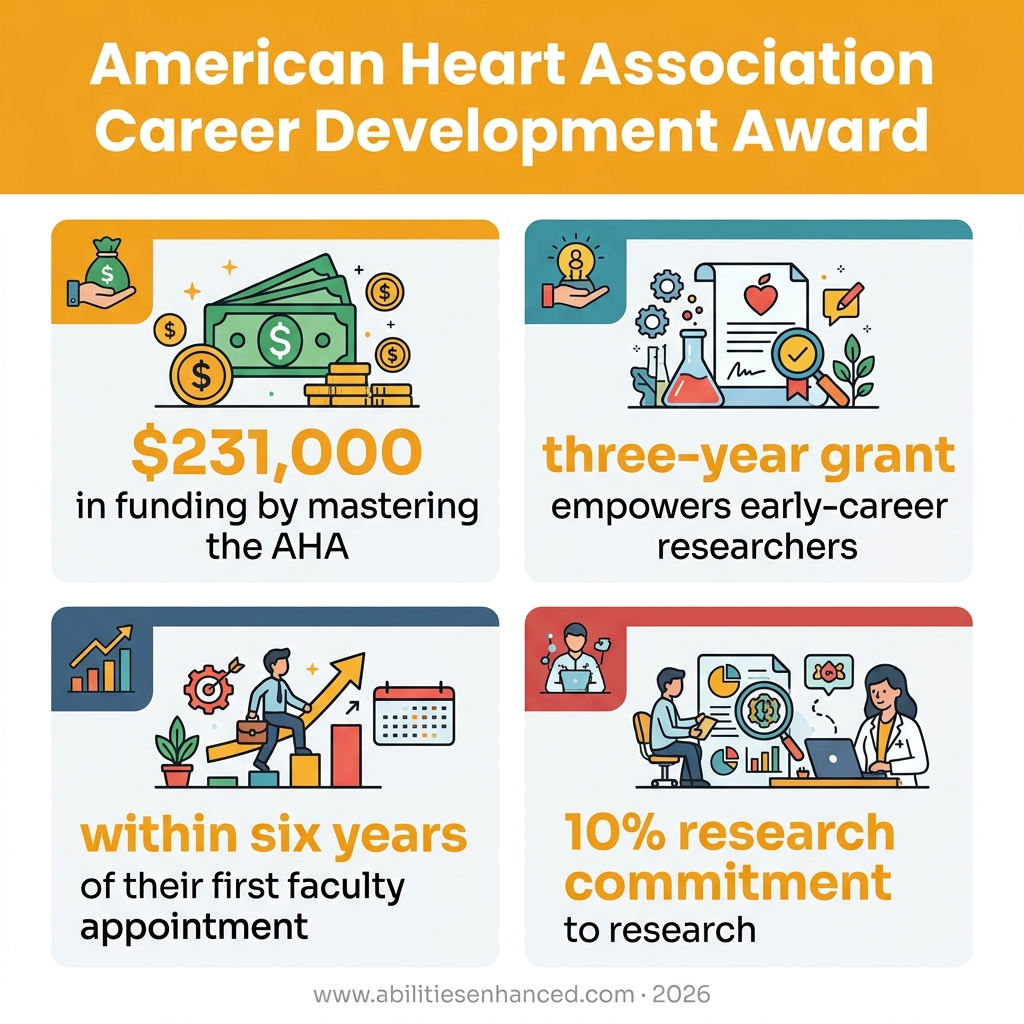
Key takeaway: Secure $231,000 in funding by mastering the AHA Career Development Award’s strict eligibility and mentorship rules! This three-year grant empowers early-career researchers within six years of their first faculty appointment to lead innovative cardiovascular studies. Act now! Ensure your 10% research commitment and institutional non-profit status to transform your scientific vision into a high-impact reality!
The American Heart Association provides $231,000 over three years to fuel the next generation of cardiovascular pioneers. Eligibility requirements are strict and non-negotiable: faculty appointment timing, institutional status, and mentorship structure must align perfectly with AHA criteria. Missing a single requirement—whether visa status, research commitment percentage, or mentor qualifications—will disqualify your application before peer review begins.
This guide breaks down every requirement to ensure your american heart association career development award application is flawless. We will master the budget rules and mentorship strategies together to launch your independent research career today!
Master the AHA Career Development Eligibility Rules
The AHA Career Development Award provides $231,000 over three years for early-career researchers (MD, PhD, DO) within six years of their first faculty appointment. Success requires a 10% research commitment and American Heart Association professional membership.
This strict research commitment is the foundation for your success, starting with a precise verification of your current academic standing and degree status.
Verify your degree and career stage
Eligible applicants must hold an MD, PhD, DO, DVM, or DDS degree. Candidates are restricted to those within six years of their initial faculty appointment at the assistant professor level.
You must guarantee a minimum 10 percent time commitment to research. This ensures sufficient focus on your scientific development.
Clinical or academic duties must not overshadow this protected time. Documenting this balance is vital for a successful application.
Secure your professional membership status
Active American Heart Association professional membership is mandatory at the time of submission. Joining connects you with a vast network of cardiovascular experts and provides access to exclusive scientific sessions.
Members also gain the opportunity to serve as peer reviewers for the association. This role offers deep insights into the grant evaluation process. It builds your reputation within the research community. Registering through the AHA portal is a straightforward but necessary step.
Check institutional and residency requirements
Non-citizens must hold specific eligible visas like J-1, H-1B, or O-1. Your host institution must be a United States non-profit organization such as a university or hospital.
Applicants cannot simultaneously hold an NIH K series grant and this award. However, you can apply if the NIH grant has not yet been officially awarded or funded.
Build a Winning Mentorship Team for Your Research
Beyond basic eligibility, the strength of your application rests heavily on the quality of your guidance and the strategic vision of your project.
Select mentors with a proven track record
You need a primary mentor and a secondary mentor to guide your progress. A cross-departmental team often adds valuable perspectives to your work. Choose mentors with established funding histories.
Evaluate their history of trainee success before finalizing your selection. Strong mentors provide more than just technical advice. They offer networking opportunities and career advocacy. Their letters of support must explicitly detail their commitment to your research independence and growth.
Effective mentorship is the backbone of this grant. It demonstrates your potential for future leadership.
Align your project with cardiovascular health missions
Your proposal must clearly link to cardiovascular or cerebrovascular health outcomes. The AHA prioritizes research that directly impacts their mission. Be explicit about how your findings will save lives.
Integrating data science or population research can significantly strengthen your proposal. These fields offer modern solutions to traditional health challenges. Mention your investigative support group to show institutional backing.
Winning the american heart association career development award requires focus. Follow these core pillars:
- Strategic alignment criteria: focus on heart disease/stroke.
- Inclusion of diverse populations.
- Innovative data methodologies.
Plan Your $231,000 Grant Budget
Once your team and mission are aligned, you must translate your scientific vision into a realistic and compliant financial plan.
Allocate funds across the three year period
The total award is $231,000, capped at $77,000 per year. These funds primarily cover your salary and fringe benefits. Remaining balances can support technician salaries or essential travel costs.
Indirect institutional costs are strictly limited to 10 percent of the total award. Ensure your finance office understands this cap early. Accurate budget planning prevents delays during the final approval.
Maximize your impact! Use this quick reference to stay within the strict American Heart Association career development award boundaries.
| Expense Category | Annual Limit | Eligible Items | Restrictions |
|---|---|---|---|
| Salary & Benefits | Within $77k total | PI, mentors, collaborators | No NIH salary cap applies |
| Project Support | Variable | Supplies, software, equipment | Must be essential to project |
| Indirect Costs | $7,000 per year | Institutional overhead | Strict 10% cap note |
| Travel | Variable | International/Domestic trips | Related to research goals |
Submit through the Proposal Central management system
All applications must go through the Proposal Central management system. Start your profile early to avoid technical glitches. You will need to upload several PDF documents following strict formatting.
Institutional official signatures are required before the final submission. Do not wait until the last day to request these. You must also select specific scientific keywords. These keywords determine which peer reviewers will evaluate your research proposal and its impact.
Avoid Common Mistakes in Early Career Grant Writing
Even with a perfect budget, small errors in narrative or timing can derail an otherwise brilliant research proposal.
Demonstrate research independence under mentorship
Showing independence while working under a mentor is a delicate balance. You must describe how this project differs from your mentor’s current work. Clearly outline your future long-term professional goals. Reviewers look for candidates who will become autonomous investigators.
Address anticipated research challenges directly in your text. This shows maturity and a realistic understanding of the scientific process.
Use strong, active language to describe your leadership role. Do not let the mentor’s reputation overshadow your own contributions.
Respect the strict 3 p.m. CT submission deadline
The 3 p.m. Central Time deadline is absolute and non-negotiable. Late applications are automatically rejected by the system. Aim to submit at least twenty-four hours before the official cutoff.
Incomplete applications face the same fate as late ones. Peer review scoring for early career investigators focuses on both the person and the project. High scores require a polished, error-free submission. Double-check every attachment and institutional signature before clicking submit.
Don’t let a technicality kill your dreams! Use this checklist to stay ahead of the clock:
- PDF formatting check
- Institutional sign-off
- Keyword selection
- 3 p.m. CT alarm
Secure your future by mastering eligibility, building a powerhouse mentorship team, and planning a precise $231,000 budget. Submit your application before the December 1, 2026 deadline to launch your independent research career in cardiovascular health. Your breakthrough starts with a winning American Heart Association career development award application.
FAQ
What are the primary eligibility requirements for the AHA Career Development Award?
To seize this incredible opportunity, you must hold a qualifying doctoral degree such as an MD, PhD, DO, DVM, or DDS at the time of your application. This award is specifically designed for rising stars who are within six years of their first faculty appointment at the assistant professor level. You must also be ready to dedicate at least 10% of your total effort to research, ensuring you have the protected time needed to innovate and lead!
Don’t forget that your professional status matters! You must be a U.S. citizen, permanent resident, or hold an eligible visa (such as H-1B, J-1, or O-1) at the time of submission. Additionally, you must be an active AHA professional member and self-register as a peer reviewer to fully integrate into our elite scientific community.
Can I apply if I already have NIH funding?
Yes, but strategy is key! You are eligible to apply if you hold a NIH K series grant (excluding K99/R00), provided there is absolutely no budgetary overlap between the two awards. However, please note that investigators who have already secured NIH K99/R00 or R01 grants are not eligible for this specific program. We want to empower those who are still building their path toward that first major independent grant!
How should I structure my mentorship team for maximum impact?
Build a powerhouse team! You are required to have a primary mentor and a secondary mentor who will champion your professional growth. To truly stand out, ensure at least one mentor is from a different department or institution. This diversity of perspective proves you are expanding your horizons and building a robust professional network!
Your mentors must have a proven track record of guiding early-career investigators toward independence. They need to provide explicit letters of support detailing their commitment to your journey. One of your mentors must also specifically pledge to guide you through the rigors of future grant writing, such as preparing a NIH R01 application. Surround yourself with excellence, and you will become excellent!
What is the total funding amount and duration of the award?
Get ready to accelerate your research with a total investment of $231,000! This generous award is distributed over three years, providing you with $77,000 annually to fuel your discoveries. These funds are flexible and can cover your salary, fringe benefits, and essential project costs like technician support, supplies, and even international travel to present your findings!
Keep in mind that institutional indirect costs are capped at 10%. This award is a non-renewable, three-year sprint designed to provide the preliminary data and specialized training you need to launch a lifelong career in cardiovascular or cerebrovascular research. Maximize every dollar to transform the future of heart health!
What must be included in my Career Development Plan?
Your plan must be a visionary roadmap for your future! In three pages or less, you need to articulate your long-term professional goals and the short-term milestones that will get you there. Be bold and specific, identify the skills, knowledge, and experiences you need to acquire to become a leader in your field, whether in academia, industry, or public health.
Transparency is vital for success! You must outline a clear timeline with 2-3 success metrics for each goal. Describe exactly how you will meet with your mentors for progress checks and what tasks you will delegate to ensure your research remains a priority. Show the reviewers that you have a proactive strategy to overcome any challenge that stands in your way!
When is the deadline for the AHA Career Development Award?
Mark your calendars and set your alarms! The deadline is strictly set for Tuesday, December 1, 2026, at 3:00 p.m. Central Time. The AHA does not accept late submissions under any circumstances, so I strongly encourage you to submit your proposal at least twenty-four hours early to avoid any last-minute technical hurdles in the ProposalCentral system!
Preparation is your best friend! The Request for Proposals (RFP) drops on April 28, 2026, and the submission portal opens on October 1, 2026. Use this time to polish your narrative, secure your institutional signatures, and double-check your PDF formatting. A flawless, timely submission is the first step toward your success!
Commentaires récents