

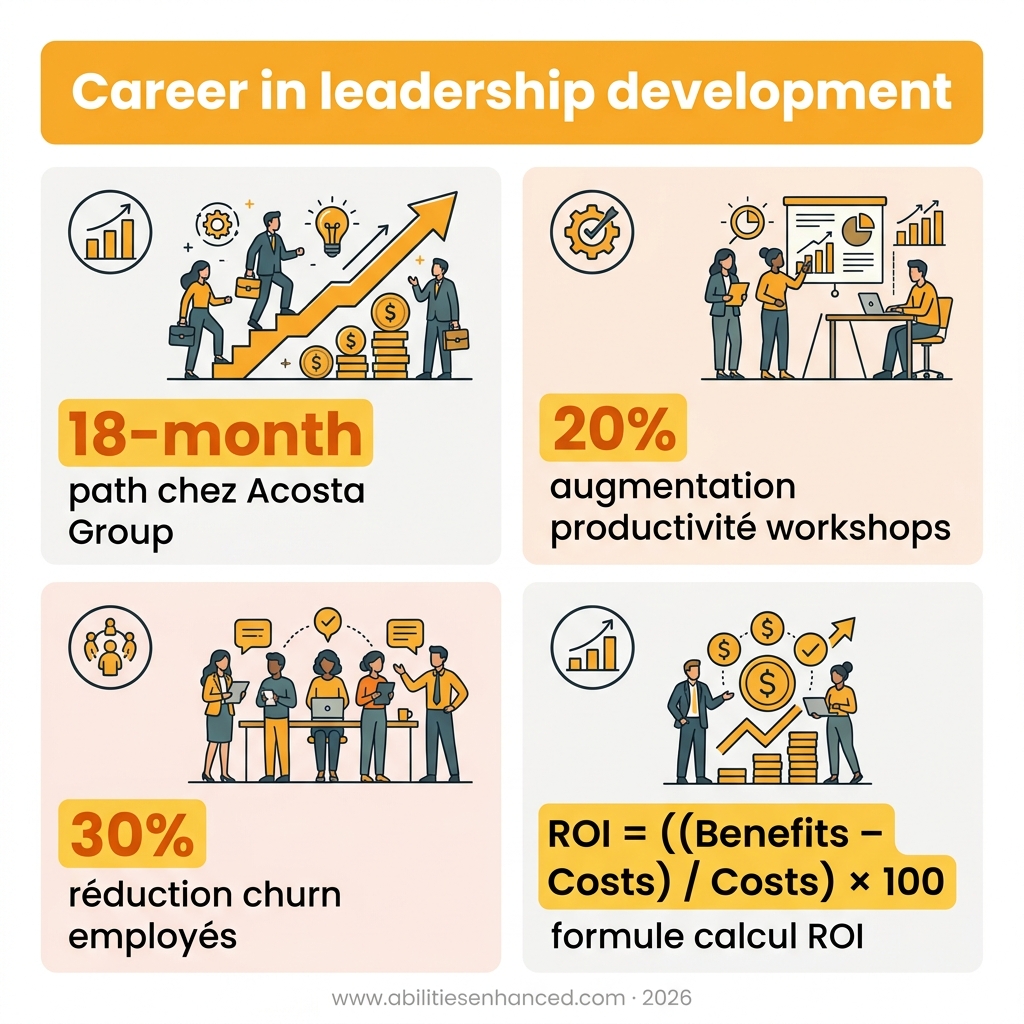
Key takeaway: Mastering leadership development requires blending structured rotations with strategic coaching to drive organizational ROI. Whether through ASCO’s clinical mentorship or Bureau Veritas’s inclusive « Elevate HER » initiative, success lies in aligning personal growth with business impact. Proven results: Programs like Le programme de développement du leadership (PDL) d’Acosta Group est un parcours transformationnel en rotation de 18 mois pour les professionnels débutants[1][3] transform high-potential talent into versatile leaders ready for immediate strategic execution!
Les entreprises avec un fort engagement des employés affichent souvent une croissance des bénéfices par action supérieure, selon certaines études[1]report earnings per share growth significantly higher than their competitors. Yet, many professionals struggle to bridge the gap between functional expertise and strategic influence. You might feel your career has hit a ceiling despite your operational success.
Mastering a career in leadership development is the key to unlocking these high-impact roles and driving organizational growth. We will explore the essential competencies and strategic pivots needed to transform you into an indispensable growth expert. Let’s map out your path to the top together!
Building a Leadership Development Career: Roles and Paths
Leadership development careers center on roles like L&D Manager or Talent Director, requiring expertise in curriculum design and coaching. Successful transitions involve leveraging operational experience and mastering ROI metrics to prove organizational impact, starting with foundational role identification.
The transition from the previous section highlights how vital it is to map out the specific functions that define this professional field.
Identifying Common Job Titles and Functions
Your journey begins with roles like Learning & Development Manager or Talent Development Director. These experts focus on closing skill gaps. They launch workshops and strategic initiatives to boost employee engagement. It is about building a stronger workforce!
Daily operations involve running training sessions and managing internal growth. Corporate leads specifically handle large-scale onboarding. They also build leadership pipelines for high-potential employees. You will work across various departments to ensure everyone is ready for the next level!
Focus on these core functions to find your fit:
- L&D Manager: strategy and facilitation
- Program Lead: project execution
- Talent Director: executive coaching and long-term planning
Comparing Corporate Roles and Non-Profit Initiatives
Corporate programs often prioritize profit-aligned skills for immediate results. In contrast, mission-driven initiatives in associations like ASCO focus on community impact. Non-profits emphasize member-driven professional growth. Both paths offer unique rewards for dedicated leaders!
Resource allocation differs greatly between these two sectors. Corporations usually have dedicated budgets for expensive digital tools. However, non-profits rely on volunteer mentorship. They use strategic stakeholder management to succeed. It is a true test of creative leadership!
| Sector | Primary Goal | Key Stakeholders | Budget Source |
|---|---|---|---|
| Corporate | Profit | Executives | Revenue |
| Non-Profit | Mission | Community | Grants |
| Educational Institutions | Education | Students/Faculty | Tuition/Endowments |
3 Core Competencies for Professional Growth
Beyond understanding the job titles, you need to master the specific skills that make a leadership expert indispensable in today’s market.
Evaluating Educational and Background Requirements
Degrees in Human Resources or Organizational Development are standard entry points. However, hands-on management experience often outweighs a formal diploma when you are designing practical, real-world leadership curricula.
Professional certifications like SHRM or ICF add significant credibility. They prove you understand the technical frameworks of adult learning and organizational behavior.
Technical knowledge of instructional design is vital. You must know how to build modules that actually change employee behavior on the job.
Mastering the Art of Coaching and Mentorship
One-on-one guidance is the backbone of talent growth. Effective leaders don’t just teach; they listen and guide employees through complex career transitions and internal challenges using psychological principles.
Building formal mentorship programs requires structure. You must match mentors and mentees based on specific skill gaps and long-term career goals.
Coaching involves deep empathy and active listening. These soft skills are what separate average managers from true leadership development experts.
Designing Curricula for Diverse Organizational Levels
Training for entry-level workers looks nothing like executive coaching. You must align learning objectives with specific business outcomes, like reducing turnover or increasing sales. Delivery methods must vary to suit different learning styles.
Use digital platforms for scale and workshops for depth. Mixing these methods ensures that the leadership message sticks across all tiers.
How Do You Pivot into Leadership Development?
If you are currently in a functional role like marketing or operations, making the jump into L&D requires a strategic personal rebrand.
Switching Lanes: Transitioning from Functional Roles
Identify transferable skills from your current role. Operations experts excel at process design, while marketers understand audience engagement. Both are vital for creating successful internal training programs.
Gain experience through internal pilot programs. Volunteer to lead a small team training or design a new onboarding document. This builds your portfolio while staying in your current job.
Build a personal brand as a growth expert. Share insights on LinkedIn to get noticed!
Tailoring Your Resume for Program-Specific Roles
Highlight results-driven training metrics on your CV. Instead of saying you « led training, » state that you « amélioré la productivité d’équipe via des ateliers ciblés, selon des retours qualitatifs dans les programmes de leadership[1][3]. » Use keywords like « talent pipeline » and « instructional design » to pass ATS filters.
Frame previous management experience as developmental expertise. Show how you mentored subordinates into higher roles. This proves your commitment to a career in leadership development.
Focus on the « why » of your methods. Explain the impact on the bottom line!
Measuring Impact and Remote-First Realities
Once you are in the role, the challenge shifts to proving that your programs actually work in a modern, decentralized office.
Proving Value Through Performance Metrics
Calculating the ROI of leadership initiatives is essential. Connect training outcomes directly to employee retention and internal promotion rates. If trained managers stay longer, your program is paying for itself.
Use 360-degree feedback for data collection. This provides a holistic view of how a leader’s behavior has changed post-training. Quantifiable data makes your case to executive leadership much stronger.
Track engagement scores religiously. High engagement usually predicts better long-term performance.
Leading in Hybrid and Remote Environments
Digital tools have fundamentally changed how we deliver leadership training. Virtual workshops and asynchronous modules allow for flexibility. However, maintaining a strong organizational culture in a decentralized workforce remains difficult.
Inclusive initiatives like Bureau Veritas’s ‘Elevate HER’ show how to support diverse talent remotely. These programs ensure that remote workers aren’t overlooked for promotions. Focus on equity in every digital interaction.
Focus on these key strategies for a career in leadership development within distributed teams:
- Use video for empathy
- Use Slack for quick coaching
- Use LMS for tracking progress
Mastering your career in leadership development requires blending strategic instructional design with impactful mentorship. Start by leading internal pilot programs to prove your value and secure your future in this high-growth field! Your journey toward transforming organizational culture and driving measurable ROI begins today.
FAQ
What are the primary job titles within a leadership development career?
The field offers a dynamic range of roles tailored to various levels of impact! You can start as a Leadership Development Specialist or a Performance Coach, focusing on individual growth. As you progress, you might step into management roles like L&D Manager or Director of Leadership Development, where you design the overarching strategy to align talent with business goals.
For those aiming for the summit, executive positions such as VP of Leadership Development or Senior Executive Development Program Lead allow you to shape the future of the organization’s highest tiers. Whether you are facilitating workshops or coaching C-suite executives, each role is a vital link in building a robust leadership pipeline!
How do corporate leadership programs differ from those in non-profits?
While both sectors strive for excellence, their « why » creates a different journey! Corporate programs are typically high-energy and results-driven, focusing on profitability, market competitiveness, and navigating digital transformation. They often have dedicated budgets for cutting-edge tools and global scaling.
In contrast, non-profit initiatives, like those seen at ASCO, are deeply mission-driven. They focus on social impact, community building, and maximizing limited resources to empower leaders who can change the world. While corporations prioritize financial ROI, non-profits measure success through social progress and the strength of their mission-aligned talent!
What specific skills are required to master a career in leadership development?
To truly excel, you must blend instructional design with deep empathy! Mastering the art of coaching and mentorship is essential; you aren’t just teaching—you are guiding people through complex career transitions. You also need the technical ability to design curricula that resonate across diverse organizational levels, from entry-level workers to executive leads.
Don’t forget the power of data-driven strategy! Being able to facilitate 360-degree feedback and analyze performance metrics is what makes you indispensable. It’s about being a visionary who can also execute with precision!
How can I accurately calculate the ROI of leadership development initiatives?
Proving the value of your programs is your ticket to the top! Use the classic formula: ROI = ((Benefits – Costs) / Costs) × 100. You must track hard metrics like increased productivity, reduced turnover costs, and improved sales performance. For example, if your training réduit le turnover des employés, selon certaines estimations issues de programmes de développement du leadership[1][2], the savings in recruitment costs are a direct win for your program!
Leverage proven frameworks like the Kirkpatrick Model or the Phillips ROI Methodology to convert behavioral changes into tangible monetary value. By showing that your leaders are staying longer and performing better, you prove that leadership development isn’t just a cost—it’s a high-yield investment!
What does a structured leadership development program look like in practice?
High-impact programs, such as the ASCO Leadership Development Program or Bureau Veritas’s ‘Leading Teams’, are immersive and multi-faceted! They typically involve a mix of interactive training sessions, 360-degree evaluations, and one-on-one coaching. These programs often span a full year, providing participants with exclusive access to senior leadership and a powerful network of alumni.
Modern programs also embrace « Remote-First » realities by using LMS platforms for tracking and virtual workshops for flexibility. Whether it’s a diversity-focused initiative like ‘Elevate HER’ or a global summit for young talent, the goal is always the same: accelerating personal growth to meet future organizational challenges head-on!
Commentaires récents