

Attention to Detail Assessment Test: What It Measures and How to Prepare
Many US job applications now include a short test before the interview, and some of them measure one skill above all: spotting small errors.
You may not know which test you will face, how it is scored, or whether practice will help. In this article, we look at what these tests measure, the formats they use, and how to prepare.
What an attention to detail assessment test actually measures
Dedicated accuracy tests that check how well a candidate spots errors
Dedicated accuracy tests check one thing above all: whether you can spot errors and keep information correct. Some of these tests also check whether you follow the instructions and stay focused on the task.
In an office or data-entry job, one wrong digit in an invoice or a customer’s address creates real problems.
So the test shows whether you catch that digit before it leaves your hands. Read every instruction first, then check each answer against it, not against your memory.
Concentration tests that measure sustained and divided attention
Concentration tests check whether you can keep focus while distractions pile up. The Criteria Attention Skills Test (CAST) measures several dimensions of attention, including selective attention, which means staying alert and filtering out distractions, as well as sustained attention and perceptual reaction time.
It also measures divided attention, which means handling more than one task.
Which test you face depends on the job. The Criteria Cognitive Aptitude Test (CCAT) checks attention to detail as one part of general aptitude. For a security officer role, see the security officer assessment test guide first.
Which employers and roles use these tests in hiring
Entry-level jobs use the CBST most often: administrative, clerical, and customer-service roles. If you apply for one, expect this test. For customer-service work, read the customer care assessment test guide first.
Mid-level and senior roles use the CCAT instead. Think manager, financial analyst, auditor, or software engineer, and many of those jobs ask for a college degree.
Several providers and job families use these tests:
- Criteria covers financial analysts, bookkeeping and accounting clerks, data-entry workers, and administrative assistants.
- Truck drivers, security guards, casino gaming dealers, and air traffic controllers take the CAST, a test that assesses multiple dimensions of attention, including sustained concentration, divided attention, selective attention, and perceptual reaction time.
- eSkill, iMocha, and EmployTest offer attention-to-detail tests aimed at clerical and proofreading work.
The formats you will face: comparisons, records, and rule checks
Exact-match and record comparisons
Exact-match questions ask you to pick the option identical to a sample. For the sample ZY96828, the answer is C, ZY96828. One changed letter makes a wrong option, so check every character.
Record comparisons ask which fields differ. In Martin Cannon 677-4413 and Martin Cannan 677-4413, only the name differs, so compare field by field. For more practice, see our career assessment tools guide.
Most of these checks hinge on one small difference between near-identical lines:
- An email can differ by one letter: Fredf@thegreatstore and Freds@thegreatstore.
- An address can differ in several fields: Gerald Jansen, 1050 Earl Dr. and Gerald Janson, 1055 Earl Dr. differ in name and number.
- A number can have two digits swapped or one added: 5696343 matches option D, while the wrong options swap two digits or add one.
Proofreading, arithmetic and rule-based checks
Proofreading questions test spelling. Find the misspelled word in a line like « The quik brown fox, » and fix it. Invoice checks ask whether a total is right. Add the figures yourself and compare them with the stated total.
Rule checks ask you to apply a threshold or date. Use only the rule given; don’t add an unstated exception.
Sample questions and answers worked through step by step
Check each character from left to right, never the whole code at a glance. For ZY96828, only C matches every position. A swaps two characters and looks almost the same.
For 5696343, only D matches digit by digit, while C differs at the fourth digit. A quick look can’t tell these apart, so check every position.
Take the name-and-phone item and compare the two records field by field:
- Names: Martin Cannon and Martin Cannan differ by one letter, so the answer is A, just in the name.
- Phone numbers: 677-4413 matches on both sides, so it can’t decide the answer.
- Transpositions: 5696343 and 5696433 have the same digits in a different order, so check them position by position.
How timing and scoring vary from one provider to the next
No standard timing or scoring exists across providers. This particular six-section sample carries no time limit, which applies only to this specific example and is not a general rule, so never assume another test runs the same way.
A percentile ranks your score against a stated group of test takers, not against a fixed pass mark. Employers set their own cutoffs for each job, so one low score isn’t automatically a rejection.
Timing and scoring change from one example to the next, so compare them side by side; for timed practice, see cognitive assessment sample test speed.
| Criterion | Six-section sample | EmployTest sample |
|---|---|---|
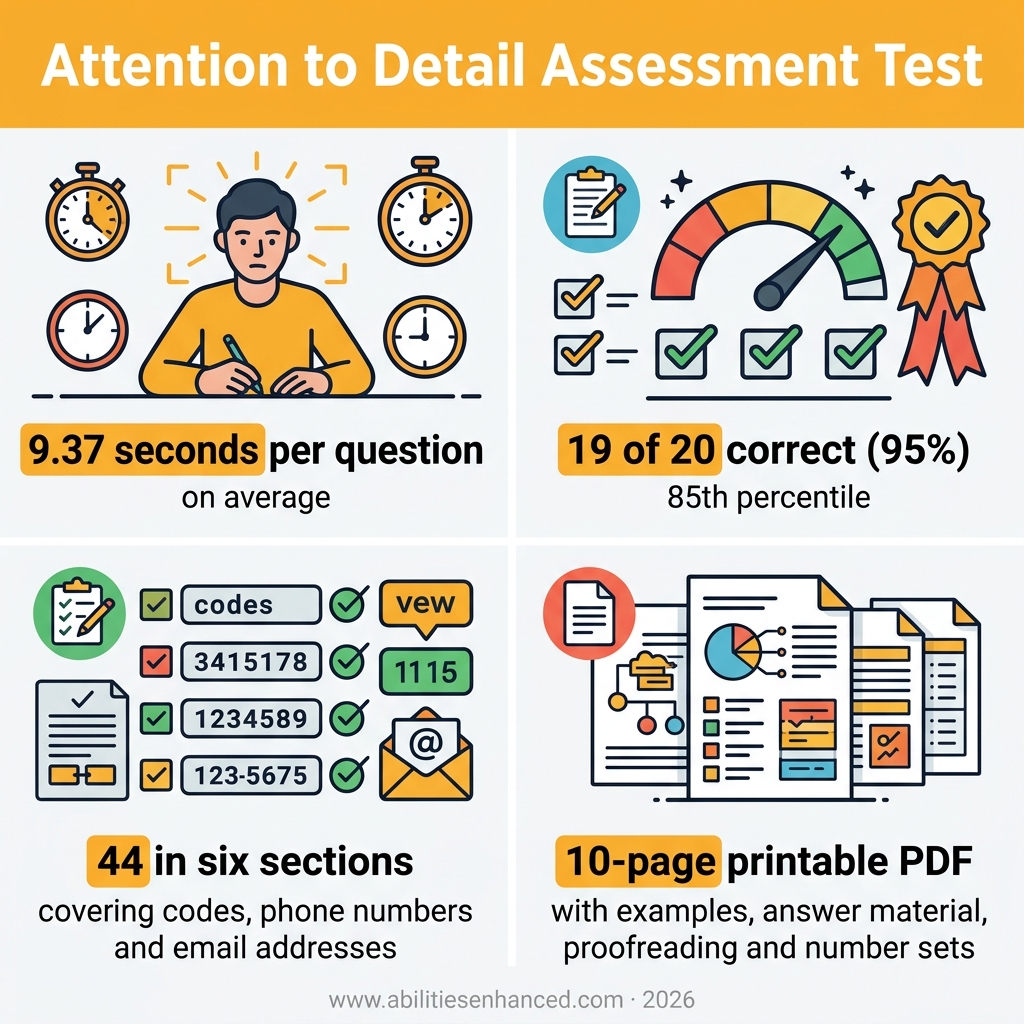
| Questions | 44 in six sections | 20 |
| Time | No time limit | 9.37 seconds per question on average |
| Score | Your error count by type | 19 of 20 correct (95%), 85th percentile |
Free practice tests and PDFs, and what they cannot tell you
Criteria offers free mini practice tests to help you recognize question types. They are shortened simulations, not copies of the full assessment, so they don’t show its real difficulty. Use them to learn the format, not to predict your score.
For more practice, ace your Wonderlic assessment practice test or try these free options:
- A 44-question sample in six sections, covering codes, phone numbers and email addresses.
- A 10-page printable PDF with examples, answer material, proofreading and number sets.
- Treat both as task practice: an employer’s test may use other questions and timing.
Preparing for the test and for the detail question in interviews
Read the directions before each section: one may ask for an exact match, another for every difference. Compare one field at a time, and check codes character by character, left to right.
Follow the stated time limit and rules. Don’t assume a calculator is allowed unless the instructions say so. Practice questions show formats, not your actual test.
Build your answer on one real case, in STAR order:
- Situation and task: the report you checked and your role in it.
- Action: the data mismatch you found and how you corrected it before sending.
- Result: the outcome you actually achieved, with a figure if you have one.
Attention-to-detail tests check one thing above all: whether you catch errors before they leave your hands. Read the directions, then compare each line field by field and each code character by character.
Next, find out which test your job uses. Then practice with a free test to learn the format, not to predict your score.
Frequently asked questions
Can you retake an attention to detail assessment test?
Whether you can retake an attention-to-detail assessment test depends on the employer and the specific test, so there is no single rule.
Check the instructions for your assessment before you try again. If they don’t cover a second attempt, contact the employer’s recruiter before you apply again.
Do these tests allow a calculator?
Calculator rules depend on the specific test, so use one only if the instructions allow it.
A calculator allowed on one test can be banned on the next, and if the directions say nothing about it, leave it in your bag.
Is a low score on one of these tests automatically disqualifying?
No, a low score does not automatically disqualify you. No single score is a universal pass mark, and each employer sets its own requirements for the job. Check the job posting, or ask the recruiter what the cutoff is.
Commentaires récents