

Unlock your potential with the best career assessment tools
Key takeaway: Stop guessing and start growing! Validated instruments like MBTI and CliftonStrengths can provide additional data points to inform your career reflection and potential pivots. By aligning your natural talents with market-ready roles, you unlock massive professional confidence and negotiation power. Transform your resume today using these scientific insights to dominate your next move!
Millions of people worldwide use psychometric data to inform their career choices and better understand their professional preferences. You deserve to move beyond guesswork and align your daily grind with your natural wiring!
We often waste years in roles that drain our energy simply because we lack objective clarity on our strengths. This guide breaks down the top career assessment tools to help you pinpoint your ideal path and negotiate the salary you truly deserve.
Select the 5 Best Career Assessment Tools for Your Next Move
Widely used career assessment tools like MBTI, CliftonStrengths, and Strong Interest Inventory provide empirical data on personality, professional interests, and talents or strengths — but they do not directly measure technical aptitudes in the psychometric sense, as a cognitive or skills-based aptitude test would. These assessments identify transferable skills and market-aligned roles, offering a structured framework for career transitions and salary negotiations through objective psychometric reporting.
Transitioning from general self-reflection to specific data requires understanding exactly what these metrics represent for your professional trajectory.
Differentiate Between Personality and Aptitude Assessments
Personality tests reveal how you work. Aptitude tests measure what you can actually do. Use both to map a pivot effectively!
Focus on technical skill gaps during a career change. Personality traits help find the right cultural fit in new industries instantly!
Once you distinguish your natural style from your hard skills, you must ensure the data you are using is actually legitimate.
Evaluate Scientific Backing and Psychometric Reliability
Look for peer-reviewed validation in assessment manuals. Avoid viral social media quizzes for serious planning. Reliability scores ensure consistent results over time!
Many widely used professional instruments are designed according to psychometric standards set out in their technical manuals, even though those standards vary from one tool to another. These tools offer deeper insights than free, unvalidated alternatives found on generic job boards. Get real results now!
Activate Your Potential with the Myers-Briggs Type Indicator
Understanding your internal wiring is the first step, and few tools are as famous for this as the MBTI.
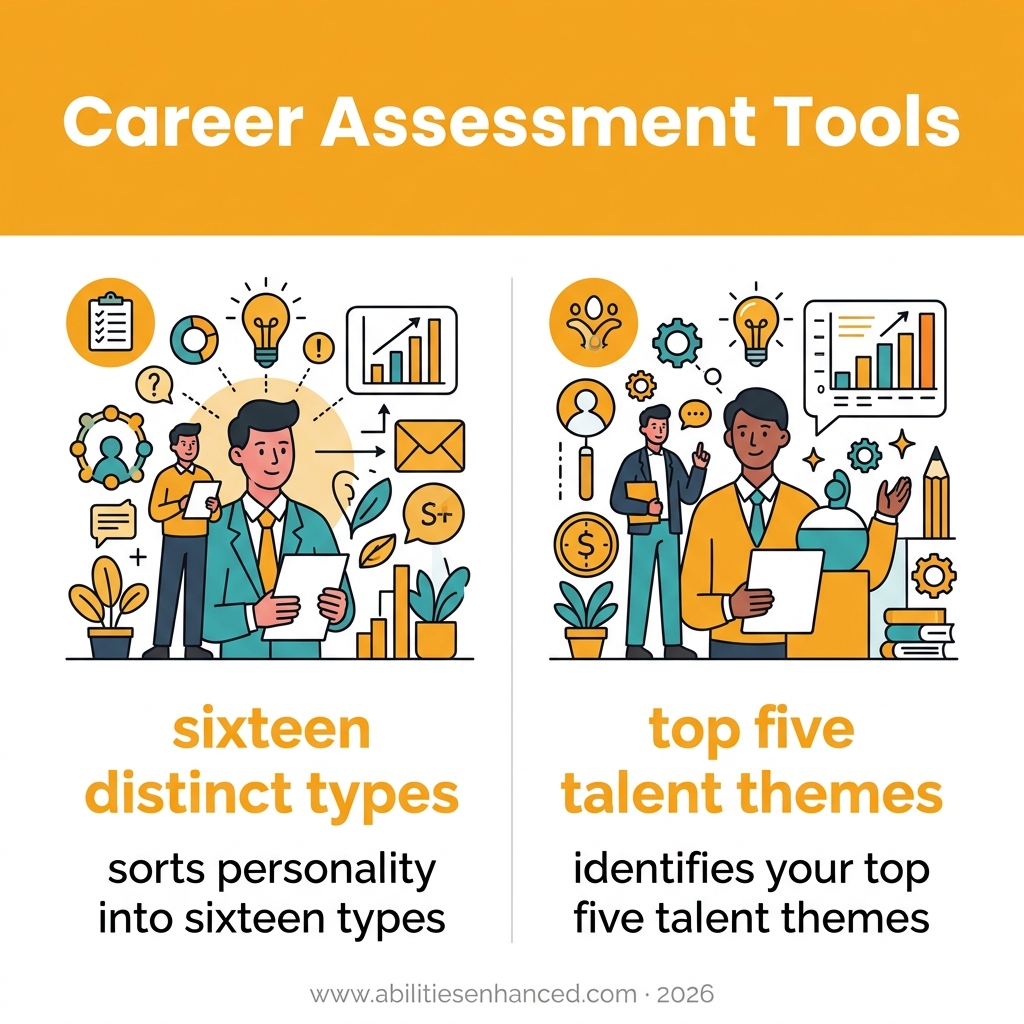
The MBTI sorts personality into sixteen distinct types based on declared preferences for how you perceive information and how you make decisions — it measures self-reported preferences, not observed behaviors or actual decision-making patterns. This helps identify preferred workplace environments.
Stop guessing about your future! Use your four-letter code to filter job roles. Take a Myers-Briggs test to align your natural strengths with the right professional path today!
Knowing you are an INTJ or ENFP clarifies team dynamics. It highlights why certain corporate cultures feel draining or energizing.
Identify Your Top Talents with CliftonStrengths by Gallup
While MBTI looks at type, Gallup focuses on your specific competitive advantages.
This assessment identifies your top five talent themes. It encourages building on strengths rather than fixing weaknesses. This approach boosts professional confidence quickly.
Focus on these four core domains to master your career trajectory:
- Strategic Thinking themes
- Relationship Building themes
- Influencing themes
- Executing themes
Use these themes to describe your unique value proposition. They provide a common language for performance reviews and growth.
Match Your Interests with the Strong Interest Inventory
Knowing what you are good at is vital, but you also need to enjoy the work itself.
This inventory compares your interests to those of satisfied professionals. It provides scores across the six RIASEC codes and a Theme Code based on the three strongest interest areas. It reveals hidden career paths.
Aligning interests with daily tasks prevents burnout. Start exploring your options through professional development training today! Use career assessment tools to secure your future happiness.
The report suggests specific occupations and leisure activities. It is particularly useful for students or mid-career professionals seeking a total industry change. Take charge now!
Discover Your True Motivation with the MAPP Test
If you feel uninspired, the Motivational Appraisal of Personal Potential might reveal why. The MAPP test focuses on what you love doing. It matches your motivations to a large number of possible careers, en proposant de multiples pistes professionnelles alignées sur vos intérêts. The degree of specificity and practical applicability of the results depends on how the tool is used and is not scientifically guaranteed.
| Assessment | Primary Focus | Best For | Cost Level |
|---|---|---|---|
| MBTI | Personality | Team Dynamics | Moderate |
| CliftonStrengths | Strengths | Personal Growth | Moderate |
| Strong Interest | Interests | Career Mapping | Moderate |
| MAPP | Motivation | Career Matching | Premium |
| Pymetrics | Cognition | Recruitment | Varies |
It helps identify if your current role lacks the necessary stimulation. Use career assessment tools to find work that feels naturally rewarding. Stop guessing and start winning!
Harness Machine Learning Insights via Pymetrics Cognitive Games
Modern career matching now uses neuroscience and algorithms to remove human bias.
Pymetrics uses cognitive games to measure traits like risk tolerance. Machine learning then matches your profile to top performers. It is a data-driven approach.
These games assess attention and altruism. Use an AI-assisted career coach to understand how these career assessment tools highlight your specific cognitive strengths!
Several large companies, including some in the Fortune 500, use Pymetrics in their recruitment and candidate assessment processes. It provides a fair way to showcase your potential without relying solely on your past resume.
Apply Your Assessment Data to Real-World Career Goals
Collecting data is only half the battle; the real magic happens when you apply it.
Update Your Resume and LinkedIn Profile with New Insights
Stop settling for generic descriptions! Use specific keywords from your career assessment tools to refine your summary. Check out these professional resume writing assistance tips to stand out immediately. Precision wins every single time!
Inject your identified strengths directly into your LinkedIn headline. This strategic move ensures recruiters find you for high-fit roles. Don’t stay invisible!
Reconcile Conflicting Results from Multiple Assessment Tools
Don’t let divergent data paralyze your progress. Look for recurring themes across different reports to find your true North. If multiple tests suggest leadership, prioritize that trait. Treat outliers as secondary signals worth revisiting later, not as definitive data points.
Synthesize all your data into one powerful, single narrative. A cohesive professional identity makes your story much more compelling. Own your unique path!
Prepare for Salary Negotiations Using Your Strength Reports
It is time to get paid what you are actually worth! Follow this salary negotiation guide to leverage your results. Use objective data to prove your value!
Show exactly how your specific talents solve company problems. Confident delivery during interviews leads to much better compensation offers. Demand your market value today!
Master your transition by aligning MBTI archetypes, CliftonStrengths talents, and MAPP motivations into a cohesive professional identity. Use these career assessment tools to bridge skill gaps and negotiate with data-driven confidence. Your dream role is waiting, seize these insights today and command the future you deserve!
FAQ
How do I distinguish between personality tests and aptitude assessments for my career?
Think of it this way: personality tests like the MBTI reveal your internal wiring and how you interact with the world, while aptitude assessments measure your actual ability to perform specific tasks. To master your next career pivot, you must use both! Use personality insights to find a culture where you’ll thrive and aptitude data to identify the technical skills you need to sharpen.
Don’t just guess your next move! Personality traits help you secure the right cultural fit in a new industry, while technical assessments highlight the exact skill gaps you need to bridge to become an unstoppable candidate.
Which career assessment tools are considered the most reliable?
Stop wasting time on viral social media quizzes! For serious professional planning, you must look for peer-reviewed validation and rigorous psychometric standards found in instruments like the Strong Interest Inventory or CliftonStrengths. High reliability scores ensure your results are consistent and scientifically sound over time.
Professional-grade tools offer deep, actionable insights that free, unvalidated job board tests simply cannot match. Demand excellence in your data to ensure your career strategy is built on a foundation of empirical truth!
What are the primary benefits of using the MBTI for professional growth?
The Myers-Briggs Type Indicator is a powerhouse for understanding how you perceive information and make critical decisions! By identifying your specific four-letter code, you can filter for job roles that align with your natural preferences, ensuring you work in an environment that energizes rather than drains you.
Whether you are an INTJ looking for strategic planning or an ENFP seeking creative communication, knowing your type clarifies team dynamics. It empowers you to navigate corporate cultures with total confidence and precision!
How can CliftonStrengths help me stand out in the job market?
Stop obsessing over your weaknesses and start doubling down on your natural talents! The CliftonStrengths assessment identifies your top talent themes across domains like Strategic Thinking and Influencing. This approach builds your professional confidence at lightning speed by focusing on your competitive advantages.
Use these specific themes to craft a unique value proposition that leaves recruiters breathless! These insights provide a powerful, common language for your performance reviews and long-term leadership growth.
What does the Strong Interest Inventory reveal about my career path?
This tool is a game-changer because it compares your interests directly to those of satisfied professionals! By utilizing the Holland Codes (RIASEC), it categorizes your preferences, whether you are Realistic, Investigative, or Enterprising, to uncover hidden career paths you might have never considered.
Aligning your daily tasks with your genuine interests is the ultimate shield against burnout. It is an essential tool for students or mid-career professionals ready to ignite a total industry change!
How do modern cognitive games like Pymetrics improve career matching?
Welcome to the future of hiring! Pymetrics uses neuroscience-based games and machine learning to measure traits like risk tolerance and attention without human bias. This data-driven approach matches your unique cognitive profile to top performers in the field, proving your potential beyond a simple resume.
Many Fortune 500 companies now use these insights to ensure fair and accurate recruiting. Harness the power of AI to showcase your altruism and cognitive strengths to the world’s leading employers!
How should I use assessment data during salary negotiations?
Turn your assessment reports into cold, hard leverage! Use objective data from your strength reports to prove your worth during the negotiation process. When you can articulate exactly how your talents solve company problems, you command a higher market value.
Confidence is key! Delivering your value proposition based on validated psychometric data often leads to significantly better compensation offers and professional respect.
Commentaires récents