

Job postings often ask for a « team player » or « good communication skills » without explaining what they mean. Many professionals read these words and wonder whether they already have what the employer wants.
This article gives you a clear definition of soft skills and helps you decide whether they apply to you.
What Is a Soft Skill?
A soft skill is a way of working with people. It covers how you communicate, how you treat others, and the attitude you bring to work.
Official texts also call these personal skills or work-readiness skills. Other words you may see are people skills, attitudes, manners, and the way you present yourself.
In practice, the list includes talking, listening, making eye contact, dressing for work, starting on time, and following through on tasks. If a job posting asks for one of these, it is asking for soft skills.
Soft skills are harder to measure than technical ones. A technical test checks one specific answer. Communication and teamwork need a different check: you watch how someone acts in a real situation.
So soft skills are a family of abilities, not one trait. In the United States, they usually fall into four areas: professionalism or work ethic, oral and written communication, teamwork and collaboration, and critical thinking or problem-solving.
Each area looks different in daily work, so start by spotting which one your tasks depend on most. To see where you stand, try un test d’évaluation de leadership pour votre progression professionnelle.
How Are They Different from Hard Skills?
Hard skills are specific, practical abilities for doing a particular task. Accounting, computer repair, and using Excel or Python are typical examples. You can usually check them directly: a formula gives the right result or it doesn’t.
Soft skills describe how you work and interact with other people. They show up in how you handle a disagreement, run a meeting, or take feedback.
Hard skills and soft skills work together in the same job.
| Criterion | Financial analyst | IT worker | Project manager |
|---|---|---|---|
| Hard skill | Analyzing financial data and preparing reports | Technical documentation and large language model skills | Technical project leadership and resource management |
| Soft skill | Communication and teamwork | Communication | Stakeholder management |
| How they combine | Shares findings with colleagues | Explains technical information to others | Works with the people the project affects |
Soft skills are learned, not born with. They start at home or in the community, then get stronger at school and at work. For a practical starting point, see ce guide pour développer votre présence exécutive et votre leadership.
What differs is how each set is taught and checked, not how much it matters. One financial-services employer said the financial part of the job is easier to teach than the soft skills.
What Does It Look Like?
Communication at work is easy to spot. Someone listens without interrupting, then gives a clear update in the next meeting. That is a behavior you can point to, not a personality trait.
Teamwork looks the same way. Two colleagues split a task and agree on who finishes each part. If you can name a recent exchange like that, you already show the behavior.
Four skills show up in concrete actions you can point to at work:
- Problem-solving: after a missed deadline, you check the facts and suggest a workable change.
- Professionalism: you arrive on time and finish the task you agreed to.
- Adaptability: when priorities shift, you adjust your plan and tell your team.
- Leadership: when a project stalls, you set the next deadline and assign each step.
Emotional intelligence at work comes down to three actions. First, you listen to the other person’s view without cutting in. Next, you notice what worries them.
Then you respond to that concern. If a colleague worries about a deadline, you offer to split the task.
Why Do Employers Care?
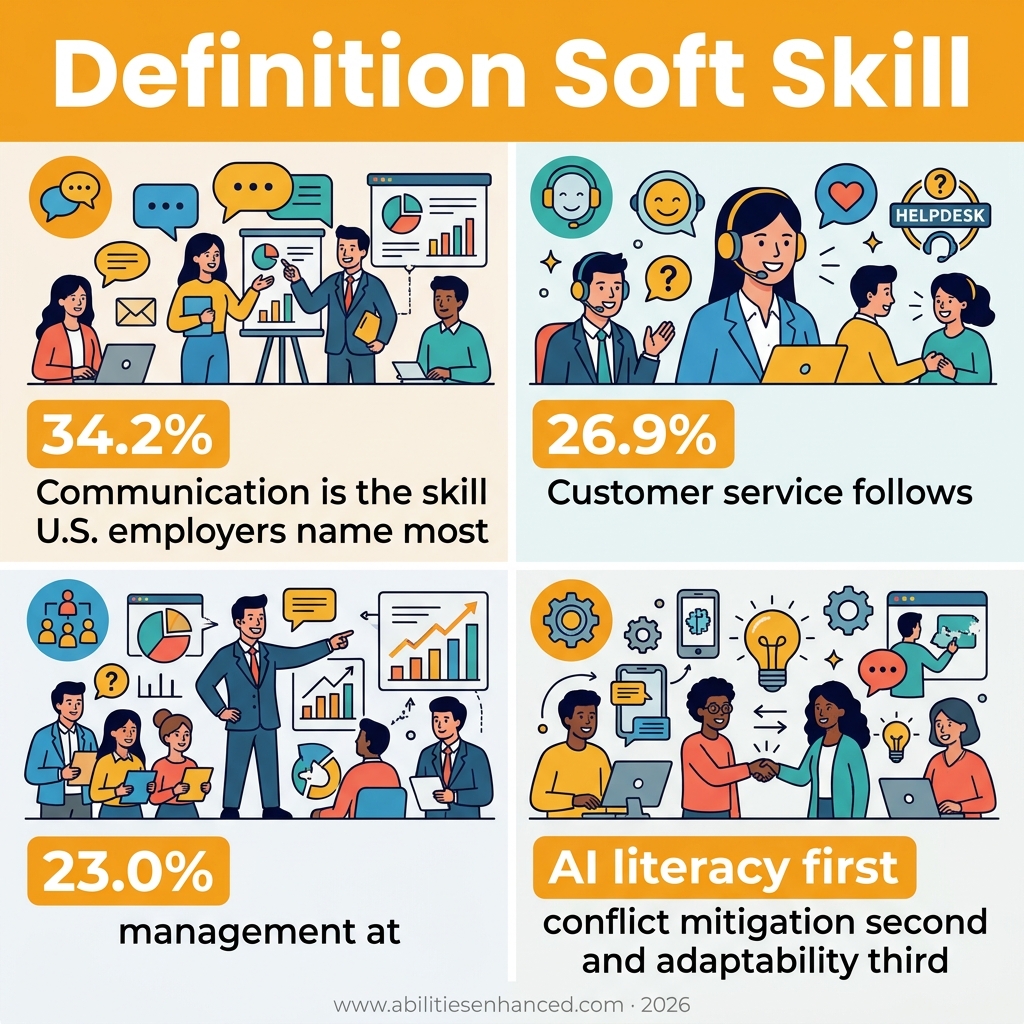
Communication is the skill U.S. employers name most in job ads, appearing in 34.2% of them. Customer service follows at 26.9%, and management at 23.0%.
If one of these matches your work, put it on your resume and back it up with an example.
Sales (16.6%), operations (15.8%) and leadership (14.6%) show up less often. They still matter if they match your field.
The U.S. Department of Labor names professionalism, communication, teamwork and critical thinking as the core work-readiness areas. LinkedIn’s 2025 U.S. ranking of the fastest-rising skills puts AI literacy first, conflict mitigation second, and adaptability third.
Both sources put these skills at the front. If your work touches one of them, name it on your resume with a concrete example. If you want to build leadership, start with des programmes de développement du leadership.
A study of supervisor ratings covered about 9,200 youth employees in one employment program. Its results describe that program only. They don’t prove the same pattern holds in your workplace.
The job-ad figures show what employers write, not how often managers screen for soft skills.
So a skill in a posting doesn’t prove it will get you promoted. Ask your manager how promotions are decided.
What Can You Do About It?
Ask colleagues, your supervisor, or a mentor for feedback on your interpersonal skills. Ask for specifics, such as what you could do differently in meetings. Vague comments are hard to act on.
Sort their comments into strengths and areas to improve. Then pick one behavior only, such as speaking up at least once in each meeting. Set a clear goal you can check.
To get better at hard conversations, build a professional development plan for career growth with these steps:
- Practice a difficult conversation through role-play with a trusted colleague or mentor.
- Rehearse conflict resolution and giving feedback, two common examples to start with.
- Take training courses on these skills so your practice keeps going.
Name the action, not the trait. NACE defines communication as clearly exchanging information and perspectives with people inside and outside an organization. Teamwork means building collaborative relationships and working toward shared goals.
Interviewers want the action, not the label. Say something like: « I listened to their concern, compared the deadlines with them, and we agreed to finish the urgent task first. » Use the same pattern in your résumé bullets.
Soft skills are how you communicate, treat others, and approach your work. Employers check them by watching what you do, not by giving a test. Start with the one your job depends on most.
Then write one recent example as a resume bullet, with the action you took. That is your next step.
Frequently asked questions
Why are they called soft skills?
Soft skills are called that because they are personal and people skills, such as communication, teamwork, and work habits, rather than a specific technical task. The word « soft » sets them against hard skills, the technical abilities tied to one task.
What are the 12 soft skills?
There is no single list of 12 soft skills in the Department of Labor framework. Instead, it sorts these skills into four core areas: professionalism or work ethic, oral and written communication, teamwork and collaboration, and critical thinking or problem-solving.
What soft skills are most lacking in the workplace?
No U.S. data says which soft skills workers lack most. The job-ad figures measure what employers ask for, not what workers are missing.
Communication is the skill employers ask for most, so it is the place to start checking your own gap.
Commentaires récents