

Key takeaway: Modern international development careers now demand a strategic blend of technical AI literacy and private-sector efficiency. Success requires bridging the gap between field-based implementation and high-level policy design. By mastering data tools like Python or Power BI and translating corporate skills into social impact, professionals can navigate diverse roles across multilateral agencies and NGOs to drive sustainable global change.
The United Nations Development Programme leverages AI-driven resources and global coaching networks to support its workforce across 170 countries. Navigating this vast ecosystem to secure a role that matches your specific ambitions for social change requires decoding the essential technical skills and strategic networking that separate stalled careers from high-impact trajectories.
The gap between field-based implementation and policy design often leaves talented professionals feeling stuck or misaligned. This guide will help you build a high-impact career international development and transform your professional trajectory today.
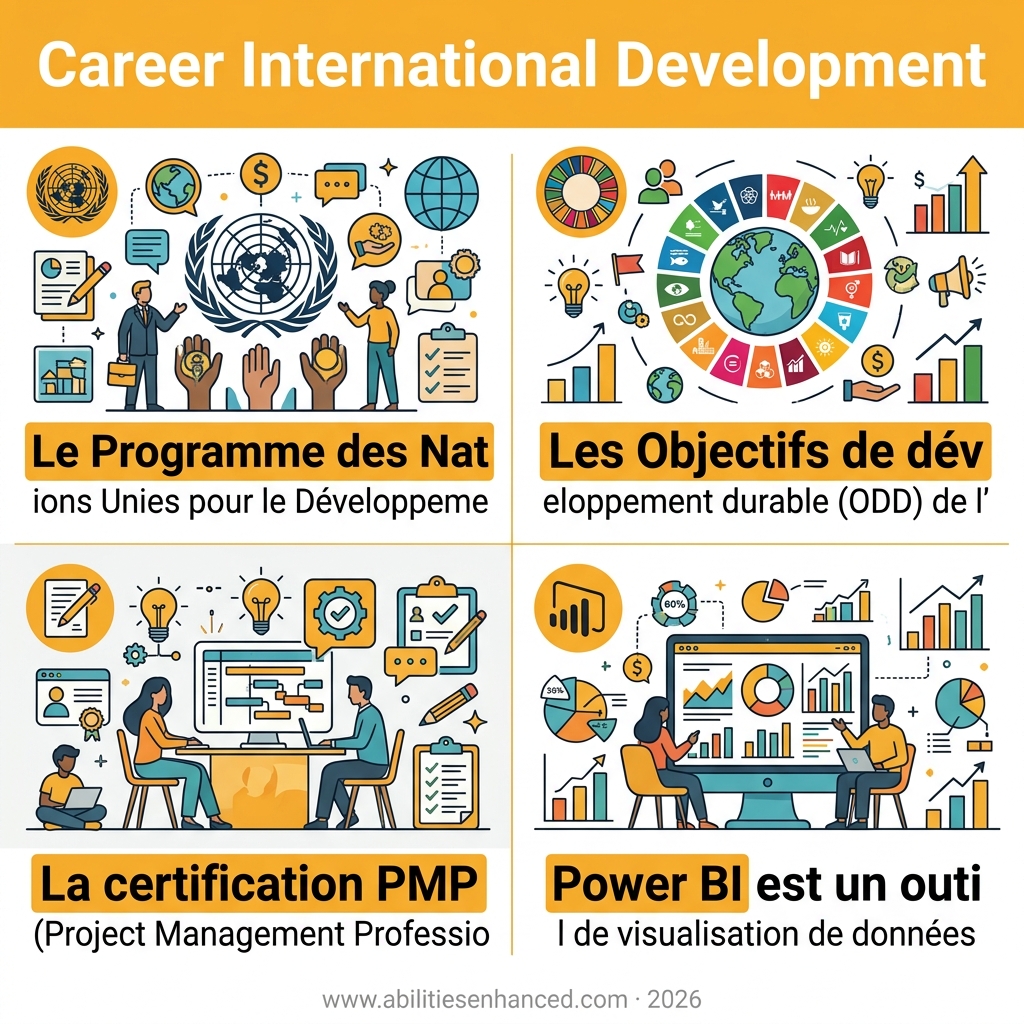
Defining the International Development Career Path
The international development sector shifts toward technical literacy in AI, private-sector partnerships, and monitoring & evaluation (M&E). Success requires bridging the gap between field-based implementation and New York or Geneva-based policy design.
Professional roles vary significantly depending on your physical and strategic proximity to decision-making centers.
Distinguishing Between Field Sites and Policy Offices
Field sites demand immediate, hands-on operational management to ensure project success. Conversely, headquarters focus on high-level strategic policy design. You must choose between direct impact and long-term systemic planning.
Project managers in the field tackle logistical coordination and daily security challenges. Research analysts in policy offices spend their time on data synthesis and reporting. Each role requires a distinct professional mindset.
Local context always dictates the actual scope of these positions. While a policy might be global, its implementation remains deeply tied to regional realities. Success depends on navigating these specific local nuances.
Identifying Primary Strategic Pillars
Core focus areas like strategic planning and funding research are non-negotiable. These pillars form the essential backbone of any sustainable international development initiative. Without them, your career international development trajectory lacks a solid foundation.
We must differentiate between monitoring and evaluation (M&E) and direct execution. M&E ensures strict accountability to donors and stakeholders. Execution focuses on delivering the actual services to the target communities.
These pillars directly connect to long-term project sustainability. Without rigorous research and evaluation, projects often fail to secure renewed funding. Lasting results require a commitment to these strategic fundamentals.
Analyzing Current Funding Flows
Shifting donor priorities directly impact your job security. When international focus moves, funding follows immediately. This often leaves specific project niches under-resourced and professionals searching for new directions.
Private philanthropy is growing rapidly compared to traditional government aid. Billionaire foundations now actively compete with or supplement state-funded programs. This shift is changing how we approach resource mobilization and partnerships.
This financial evolution significantly impacts career trajectories. Professionals must remain comfortable working across both public and private financial landscapes. Adapting to these diverse funding sources is essential.
Finding Your North Star for Global Impact
Knowing where you personally fit within the development ecosystem determines whether you thrive or burn out within five years.
Aligning Personal Values with Sustainable Goals
What specific social changes drive your passion? Identifying your core motivations is the first step. You must understand exactly why you want to serve in this demanding sector.
Match these drivers with specific UN Sustainable Development Goals. This alignment categorizes your expertise effectively. It makes you significantly more attractive to specialized recruiters looking for dedicated mission-driven talent.
Value alignment acts as a vital psychological buffer. In high-pressure roles, purpose prevents professional burnout. Staying connected to your « why » ensures long-term engagement despite the inevitable daily frustrations.
Choosing Between Global Hubs and Grassroots Engagement
Major hubs like New York or Geneva offer undeniable advantages. These cities provide high-level networking opportunities. You gain direct access to major decision-makers and global policy influencers.
Contrast this with the rewards of grassroots community work. Field roles offer immediate, visible impact. You develop a deep, practical understanding of the people and programs you serve every day.
These geographic choices dictate your long-term growth trajectory. Hubs help you build essential political capital. Conversely, the field builds the technical and cultural credibility required for authentic career international development.
Evaluating Long-Term Career Sustainability
Prioritizing mental health is a professional necessity, not a luxury. The sector is notoriously demanding and unpredictable. Proactive self-care and work-life integration are essential for anyone playing the long game.
Watch closely for signs of mission drift. Professionals must regularly audit their daily tasks. Ensure your current workload still aligns with your original goals for creating a meaningful global impact.
Focus intensely on building personal resilience. Staying in development for decades requires immense adaptability. You must navigate shifting political climates and setbacks without losing your fundamental sense of hope.
Mastering Technical Skills for the Future Sector
Technical competencies now separate candidates who receive interviews from those whose applications never leave the inbox.
Integrating AI and Data Analytics in Development
AI significantly improves project monitoring and resource allocation. Machine learning models now predict food shortages with high precision. These systems also track disease outbreaks to ensure faster response times.
Professionals must master specific tools to remain competitive in the field:
- Excel for fundamental data management.
- Power BI or Tableau for advanced visualization and dashboards.
- Python or R for complex statistical analysis and modeling.
Recruiters increasingly seek tech-literate candidates for non-tech roles. Program managers must now interpret data dashboards independently. This shift makes digital fluency a non-negotiable asset for career international development.
Developing Cross-Cultural Intelligence and Adaptability
Effective communication requires navigating diverse cultural contexts with precision. It involves active listening and decoding non-verbal cues. These signals vary significantly between regions and influence project success.
Building trust with local partners requires specific, respectful techniques. Showing genuine respect for local traditions is a baseline requirement. Co-creating solutions always outperforms imposing external frameworks from a distance.
Cultural intelligence serves as a powerful professional differentiator. The ability to bridge cultural gaps is often more valuable than degrees. It is the « blind spot » most professionals overlook during their transition.
Managing Budgets and Finances for Projects
Financial management is a core pillar within non-profit frameworks. Understanding the difference between restricted and unrestricted funding is vital. Every project lead must master these basics to avoid operational friction.
Donors require meticulous documentation for every cent spent. Meticulous expenditure tracking ensures that dollars reach their intended destination. This transparency prevents waste and maintains the integrity of global initiatives.
Fiscal transparency is directly linked to your professional credibility. Managers who handle budgets well are trusted with larger programs. Mastering the numbers is the short-term play that secures the long game.
How do you shift from corporate to international development?
Corporate professionals bring efficiency and results-orientation that development organizations desperately need—if they can translate their experience into the sector’s language.
Translating Private Sector Experience to Impact
Identify corporate skills like logistics and marketing. These are highly transferable to aid work, where supply chains and advocacy are critical components. You must reframe your expertise to match NGO priorities.
| Corporate Term | Development Equivalent | Key Value |
|---|---|---|
| Profit | Impact | Social return on investment. |
| Customers | Beneficiaries | Focus on service delivery. |
| Market Share | Reach | Expanding program influence. |
| Efficiency | Sustainability | Long-term resource management. |
| Competition | Partnership | Collaborative stakeholder engagement. |
Frame profit-driven results as impact-driven successes. Focus on how your efficiency saved resources that can now be redirected to social good. This shift proves your commitment to the mission.
Acquiring Necessary Certifications and Credentials
List recognized certifications like PMP or specialized NGO management courses. These provide a standardized language that development recruiters recognize immediately. They signal that you speak their specific professional dialect.
Evaluate the ROI for a master’s degree in global affairs. While expensive, it offers a network and theoretical depth that can accelerate mid-career transitions. It bridges the gap between ambition and execution.
Explain how credentials bypass lack of field experience. A solid certification proves you understand the specific compliance and reporting standards of the sector. It serves as a vital credibility test for outsiders.
Pitching Your Value to Development Recruiters
Structure your resume for an industry in flux. Highlight adaptability and your ability to work in resource-constrained environments. Show them you can thrive even when the corporate safety net is gone.
Provide a script for the « pivot » interview. Focus on why your corporate background makes you a more effective, results-oriented development professional. Emphasize that you bring a strategic edge others might lack.
Emphasize cross-sectoral knowledge. The ability to speak both « business » and « impact » is a rare and highly sought-after skill in modern development. This dual fluency is your greatest career international development asset.
Building a High-Impact Personal Brand
Digital visibility and narrative clarity determine whether decision-makers remember your name when opportunities arise.
Storytelling and Reporting Results for Stakeholders
Use narrative techniques to demonstrate success. Facts inform, but stories about individual lives changed by a project are what truly move donors. Authentic storytelling transforms data into human reality.
Combine hard data with human-centered stories. A report showing a 20% increase in literacy is stronger when paired with a student’s personal testimonial. This creates a deep emotional link with your mission.
Detail storytelling’s role in securing funding. Compelling narratives help projects stand out in a crowded field of competing international priorities. Stories prove your effectiveness in a tangible way.
Using Professional Platforms for Visibility
Connect with global leaders on LinkedIn. Engaging with their content and sharing relevant articles builds your visibility within specific development niches. Visibility must be paired with high-value content.
Share thought leadership that emphasizes impact. Write short posts about lessons learned in the field or your take on current industry trends. Innovation starts by reframing existing narratives.
Explain how digital presence leads to remote work. Many organizations now recruit specialists they find through their professional online contributions. Your career international development strategy depends on this digital credibility.
Finding Mentorship and Professional Guidance
Identify a mentor within your specific niche. Look for someone whose career path mirrors the one you wish to take. A mentor provides a crucial space for growth.
Approach experts for informational interviews. Be specific about what you want to learn and respect their time by coming prepared with questions. Direct engagement accelerates your professional advancement.
Mention the benefits of peer-to-peer mentoring. Sometimes, colleagues at your own level provide the most practical, day-to-day advice for navigating challenges. Building these connections strengthens your long-term career resilience.
Mapping the Hierarchy of Development Organizations
Organizational culture varies dramatically across multilateral agencies, international NGOs, and private foundations—each requiring different entry strategies.
Working for Multilateral Agencies and Donors
Recruitment for the UN and World Bank is rigorous. These lengthy processes demand specific core competencies. You must often master multiple languages to qualify.
Large donor agencies provide unmatched professional stability. They offer excellent benefits packages for staff. You gain the unique chance to influence global policy scales.
However, massive bureaucracies often move quite slowly. This pace can frustrate agile-minded professionals. Impact takes time within these complex institutional structures.
Thriving in International and Local NGOs
Global NGOs possess vast operational resources. Conversely, local groups maintain deeper community ties. They navigate cultural nuances that larger entities might miss.
Career progression requires significant professional flexibility. You will likely rotate between field assignments. Moving into regional management roles builds a diverse portfolio.
Success requires a « jack-of-all-trades » tactical mindset. You must handle logistics and donor relations simultaneously. Adaptability is a non-negotiable trait for career international development success.
Exploring Private Sector Partnerships and Philanthropy
Corporate Social Responsibility (CSR) is expanding rapidly. Many companies now employ dedicated development teams. These units execute projects that align with business goals.
Roles bridging business and aid are emerging. You need to understand complex market dynamics. A firm commitment to social impact remains absolutely essential.
Public-private partnerships present distinct ethical challenges. Balancing profit motives with humanitarian needs is difficult. You must maintain very clear boundaries during negotiations.
Handling the Realities of Global Professional Life
Day-to-day logistics—from visa renewals to time-zone coordination—shape your effectiveness as much as technical expertise.
Adapting to Hybrid and Remote Work Models
International projects now favor digital coordination over constant travel. Many organizations use sophisticated software to manage field teams remotely. This shift reduces the need for a permanent on-site presence.
Managing global teams requires strict communication protocols. You must respect diverse time zones and cultural holidays. Success hinges on aligning these schedules without compromising the team’s local work-life balance.
Remote models significantly boost accessibility for diverse talent. Professionals from the Global South can now lead major initiatives. They no longer face the mandatory requirement of relocating to Western hubs.
Balancing High-Pressure Environments and Well-being
Emergency response roles carry immense emotional weight. Working in conflict zones or disaster areas demands high resilience. Without a robust support system, the risk of professional burnout becomes a reality.
You must prioritize physical health to sustain high performance. Regular exercise and digital detoxes are non-negotiable for isolated staff. Maintaining consistent family connections acts as a vital buffer against stress.
Organizations are finally evolving to protect their human capital. Many now provide mandatory « rest and recuperation » (R&R) periods. Access to professional counseling is becoming a standard benefit for all field staff.
Planning for Geographic Mobility and Transitions
Frequent relocation dictates the rhythm of a career international development path. Moving every few years reshapes personal relationships and financial goals. Long-term retirement planning requires a highly strategic and adaptable approach.
Managing these transitions effectively demands a structured checklist to avoid common pitfalls:
- Update medical records and vaccinations for all family members.
- Secure local housing and understand regional lease regulations.
- Research school options and enrollment deadlines for children.
- Notify professional networks and update your location on digital platforms.
Digital platforms are your best tool for maintaining professional continuity. They allow you to stay visible to former colleagues during moves. Your network remains your most valuable asset, regardless of your current station.
Scaling Your Impact Through Leadership
Senior roles demand shifting from hands-on execution to strategic vision—a transition many technical experts struggle to make.
Advancing into Executive Planning Roles
Identify leadership qualities for large programs. You need a mix of political savvy, financial acumen, and the ability to inspire diverse teams. High-level career international development success demands this strategic blend.
Explain the transition from technical expert to decision-maker. It requires letting go of the « how » and focusing on the « why » and the « where next. » You must shift from executing tasks to defining the broader organizational vision.
Detail executive leadership’s role. Leaders shape the mission, ensuring the organization stays relevant as global needs and funding landscapes continue to evolve. They act as the ultimate stewards of institutional longevity and social relevance.
Measuring and Evaluating Program Success
Provide frameworks for long-term effectiveness. Use Theory of Change or Logical Frameworks to map out how specific activities lead to lasting social impact. These tools clarify the link between immediate actions and final goals.
Link rigorous evaluation to professional authority. Leaders who can prove their programs work with hard evidence carry more weight in global policy discussions. Data-backed results transform anecdotal success into undeniable, scalable institutional credibility.
Use evaluation data to drive change. If the data shows a project is failing, a strong leader has the courage to pivot or close it. Genuine impact requires the bravery to abandon ineffective strategies quickly.
Mentoring the Next Generation of Professionals
Explain the responsibility of guiding new entrants. Sharing your hard-won wisdom ensures that the mistakes of the past are not repeated by newcomers. This transfer of knowledge protects the future of the entire sector.
Create inclusive environments for junior staff. Actively seek out diverse voices and provide them with the tools and opportunities they need to succeed. Empowerment starts by opening doors that were previously locked for others.
Mentoring strengthens the entire sector. By investing in people, you scale your impact far beyond what you could achieve through individual projects alone. Your legacy is defined by the leaders you help to build.
Mastering technical literacy and bridging the gap between field implementation and policy design is essential for a thriving career international development. You must align your personal values with strategic pillars like M&E and diverse funding flows to secure your future impact. Start refining your cross-cultural intelligence today to lead the sustainable global transformations of tomorrow!
FAQ
How can I transition from a corporate role into international development?
Shifting from the private sector to global impact is entirely achievable by rebranding your existing expertise. Core corporate skills like supply chain logistics, marketing, and financial management are highly sought after by organizations like the UNDP to improve project efficiency and market-linked sustainability.
To make your profile stand out, focus on translating your business wins into development language. For instance, frame « profit » as « impact » and « market share » as « community reach, » demonstrating how your results-oriented mindset can accelerate the achievement of the Sustainable Development Goals (SDGs).
What are the essential technical skills for a modern development career?
The sector is currently undergoing a massive digital transformation, making data literacy and AI integration non-negotiable. Professionals who can master tools like Excel, Power BI, and Python to track disease outbreaks or predict food shortages are in high demand to drive evidence-based decision-making.
Beyond data, you must develop strong cross-cultural intelligence and financial acumen. Being able to manage complex budgets within non-profit frameworks while building deep trust with local partners ensures that your projects are both fiscally responsible and culturally resonant.
Which certifications are most recognized in the international development sector?
The Project Management Professional (PMP) certification is a gold standard that provides a universal language for leading complex global projects. Organizations like the UNSSC even offer dedicated PMP paths to ensure staff can manage the rigorous reporting and compliance standards required by major international donors.
Specialized credentials in NGO management or advanced degrees in global affairs also offer significant returns on investment. These certifications prove to recruiters that you possess the technical depth and strategic framework necessary to handle high-stakes humanitarian and development initiatives.
What kind of career support do major organizations like the UNDP provide?
Leading agencies offer a holistic approach to professional growth that moves beyond traditional vertical promotion. This includes access to AI-driven learning resources, global mentorship programs, coaching, and webinars designed to foster both functional and geographic mobility across diverse teams.
Whether you are in a Personnel Service Agreement (PSA) for a specific project or a permanent role, you are encouraged to explore various « streams » such as corporate operations or policy design. This ecosystem ensures you stay agile and competitive in fields ranging from environmental governance to crisis response.
How do I maintain my well-being while working in high-pressure field sites?
Success in this sector requires immense emotional resilience, especially when stationed in conflict or disaster zones. It is vital to utilize organizational supports like mandatory Rest and Recuperation (R&R) periods and professional counseling services to prevent burnout and maintain long-term effectiveness.
On a personal level, maintaining proactive self-care routines—such as regular exercise and digital detoxes—is a professional necessity. Building a strong support network of peers who understand the unique challenges of geographic mobility will help you stay grounded as you transition between global hubs and grassroots assignments.
What is the role of a Data Analyst in a development organization?
A Data Analyst, particularly in organizations like the IDRC, acts as a bridge between raw information and strategic action. You will be responsible for capturing data assets, mapping information flows, and creating visualization dashboards that allow leaders to measure the real-world impact of their programs.
This role is critical for business intelligence and governance, ensuring that all data remains high-quality, secure, and compliant with privacy laws. By transforming complex datasets into actionable perspectives, you enable the organization to optimize resource allocation and prove its success to stakeholders.
Commentaires récents