

Key takeaway: Mastering a Python assessment test is the ultimate catalyst for your career transition! By proving your fluency in core syntax, OOP, and algorithmic optimization, you provide recruiters with objective technical benchmarks. Use list comprehensions and clean code to stand out! High scores don’t just build confidence, they transform your CV into a high-performance asset!
A python assessment test is how recruiters separate those who write clean code from those who just claim to. You might have the knowledge, but failing to demonstrate core syntax and algorithmic optimization in a live environment will stall your professional growth regardless of your experience level.
I will help you crush these technical benchmarks by mastering everything from data structures to OOP principles. We are going to refine your coding fluency together so you can walk into your next interview with unstoppable confidence!
Master Your Career With a Python Assessment Test!
Professional Python screenings evaluate core syntax, data structures, and OOP principles to filter candidates. Success requires mastering list comprehensions and algorithmic optimization, distinguishing software engineers from data scientists through specific technical benchmarks and live coding performance.
The following section breaks down the specific technical building blocks you must master to ace these high-stakes evaluations.
Identify Core Components of Professional Screenings
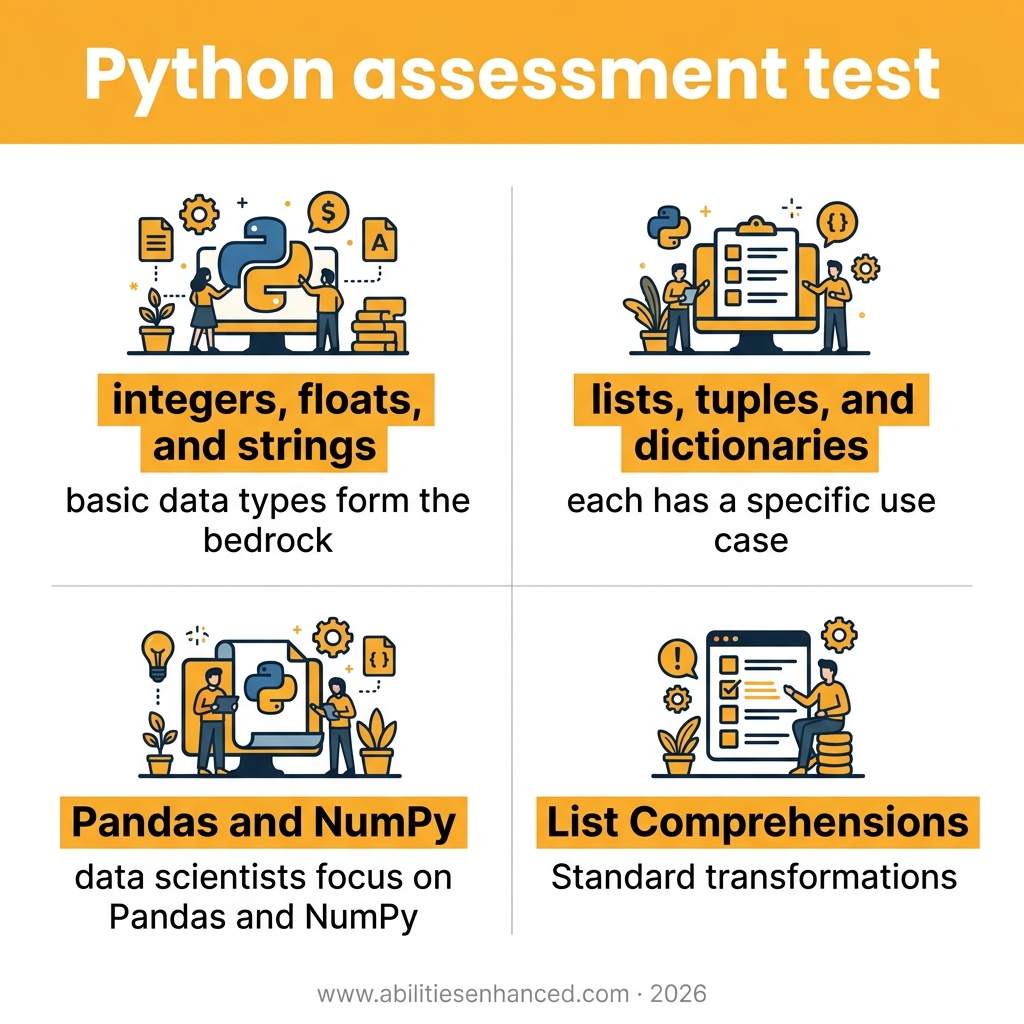
Focus on integers, floats, and strings. These basic data types form the bedrock of every technical assessment you will face today. You must handle them with absolute precision!
Logic depends on if-else statements and loops. Recruiters watch how you handle these control flow structures to gauge your fundamental coding fluency and logical speed. Show them your speed!
Basic syntax errors kill applications. Mastery here is non-negotiable for any career transition. Get it right!
Understand Why Hiring Managers Rely on Technical Benchmarks
The transition from fundamental syntax to organizational needs is where your strategic preparation truly pays off for your career.
Hiring managers use objective benchmarks to strip away bias. They need to see if you can actually ship clean code under pressure. It is a filter for technical proficiency that resumes simply cannot provide to an executive recruiter. Win them over!
Data scientists focus on Pandas and NumPy. Conversely, software engineers must demonstrate deep architectural thinking and system design. Know your specific path!
Knowing the difference saves time. Target your practice toward the specific role you want. Start practicing now!
Conquer the Fundamental Pillars of Python Logic
While understanding the « why » behind tests matters, the « how » depends entirely on your grasp of Python’s internal logic and data handling.
Master Data Structures and Control Flow Patterns
You must distinguish between lists, tuples, and dictionaries. Each has a specific use case. Choosing the wrong one signals a lack of memory management awareness to the interviewer.
Select the right tool for the job!
- Lists for ordered mutable data
- Tuples for fixed sequences
- Dictionaries for key-value mapping
- Sets for unique element collections
Efficient for loops and while loops keep your scripts running smoothly. Avoid nested loops where possible. This demonstrates your commitment to algorithmic thinking and performance tuning during the test.
Implement Robust OOP and Error Handling Protocols
Object-Oriented Programming is about more than just classes. You need to prove you understand inheritance and encapsulation. These concepts allow for maintainable code that scales. Show the interviewer you can build systems, not just small scripts.
Professional code never just crashes! Use try-except blocks to handle exceptions gracefully. This proves you are thinking about the end-user experience and system stability in production environments.
Custom class design and operator overloading add a professional touch. These advanced techniques separate the seniors from the juniors in a python assessment test.
Elevate Your Code With Advanced Architectural Thinking
Moving beyond basics requires a shift toward architectural elegance, where efficiency becomes as important as functionality.
Write Pythonic Code for Performance Tuning
Pythonic code uses list comprehensions and enumerate. It is cleaner than legacy loops. Interviewers look for this specific style to confirm you are a true Python professional.
| Approach | Syntax Example | Performance Impact | Recommended Use |
|---|---|---|---|
| Legacy Loops | for i in range(len(x)): | Low | Avoid for simple lists |
| List Comprehensions | [x for x in data] | High | Standard transformations |
| Generator Expressions | (x for x in data) | High | Large datasets / Memory saving |
| Map/Filter functions | map(func, data) | Medium | Functional programming tasks |
Focus on memory management. Avoid creating massive objects in memory when generators can do the job more efficiently!
Optimize Algorithms and Standard Library Integration
You must master stacks, queues, and trees. These are the building blocks of data structure optimization. Without them, you will struggle with complex technical assessments and interviews!
Use the standard library whenever possible. Don’t reinvent the wheel! Integration with JSON serialization is a common task that tests your ability to handle external data formats.
Algorithmic thinking solves problems faster. Practice Big O notation to explain your choices. This shows the hiring manager that you value performance tuning and code efficiency above all else!
Execute a Winning Preparation Strategy for Live Coding!
Even the best architects fail without a solid execution plan for the high-pressure environment of a live technical interview.
Practice Debugging and Real-World Application Tasks
Practical debugging is a vital skill. Analyze broken snippets to find logical errors. This mirrors the real-world tasks you will face in a professional Python screening environment.
Build a mini inventory management system. This project forces you to use dictionaries and classes together. It provides concrete architectural proof of your coding abilities to recruiters.
- Step 1: Read requirements carefully
- Step 2: Outline logic before typing
- Step 3: Test edge cases
- Step 4: Refactor for readability
Manage Time Pressure During Technical Interviews
Time pressure ruins many great developers. You must practice live coding with a timer. Focus on getting a working solution first. You can always optimize the code once the primary logic is functioning and passing basic tests.
Familiarize yourself with Git integration. Most tests require version control knowledge. Showing you can commit code cleanly demonstrates professional workflow habits that hiring managers deeply value today.
Stay calm and communicate your thought process. Often, the interviewer cares more about your problem-solving approach than the final syntax.
Mastering core syntax, data structures, and OOP logic is what separates top-tier candidates from the rest. By practicing live coding and optimizing algorithms, you will be ready to crush any professional Python screening. Take action now and turn your technical proficiency into a powerful competitive advantage!
FAQ
What exactly is a Python assessment test?
A Python assessment test is a dynamic evaluation tool designed to measure your coding proficiency and technical knowledge! It is a high-stakes method used by top-tier recruiters to filter candidates and by online learning platforms to track your incredible progress as a developer.
These tests typically cover everything from core syntax and data structures to advanced object-oriented programming. Whether it is a multiple-choice quiz or a live coding challenge, the goal is to prove you can write clean, efficient, and functional code that works in the real world!
What core concepts should I master for a Python screening?
You need to dominate the fundamentals to succeed! Focus your preparation on basic data types like integers, floats, and strings, and ensure you have a flawless grasp of control flow structures such as if-else statements and loops. These are the bedrock of your technical fluency!
Beyond the basics, you must prove your expertise in data structures like lists, tuples, and dictionaries. Mastering OOP principles, specifically classes, inheritance, and encapsulation, will set you apart as a professional who builds scalable systems rather than just simple scripts!
How do assessment goals differ for data scientists and software engineers?
The focus shifts based on your target role, so you must align your practice accordingly! For data scientists, benchmarks often center on data manipulation using Pandas or NumPy and the efficiency of machine learning algorithms. It is all about how you handle large datasets!
In contrast, software engineers are evaluated on architectural thinking, system design, and robust error handling. Recruiters for these roles want to see your ability to integrate with the standard library and manage memory effectively to build production-ready software!
Why are list comprehensions preferred over legacy loops in tests?
Writing Pythonic code is a major signal of professional maturity! List comprehensions are faster and more readable than traditional loops, showing interviewers that you value performance tuning. Using these modern techniques demonstrates that you are a true Python pro who writes elegant code!
However, for massive datasets, you should use generator expressions to optimize memory management. Choosing the right tool for the job proves your commitment to code efficiency and high-level algorithmic thinking, qualities every hiring manager dreams of finding!
How can I manage time pressure during a live coding challenge?
Preparation is your secret weapon against the clock! Always practice with a timer to simulate the technical interview environment. Your priority is to deliver a functional solution first, you can always refactor and optimize your logic once the basic tests are passing!
Don’t forget to communicate your thought process clearly! Often, the interviewer is more interested in your problem-solving approach and how you handle edge cases than perfect syntax on the first try. Stay calm, outline your logic, and you will conquer the pressure!
Commentaires récents