

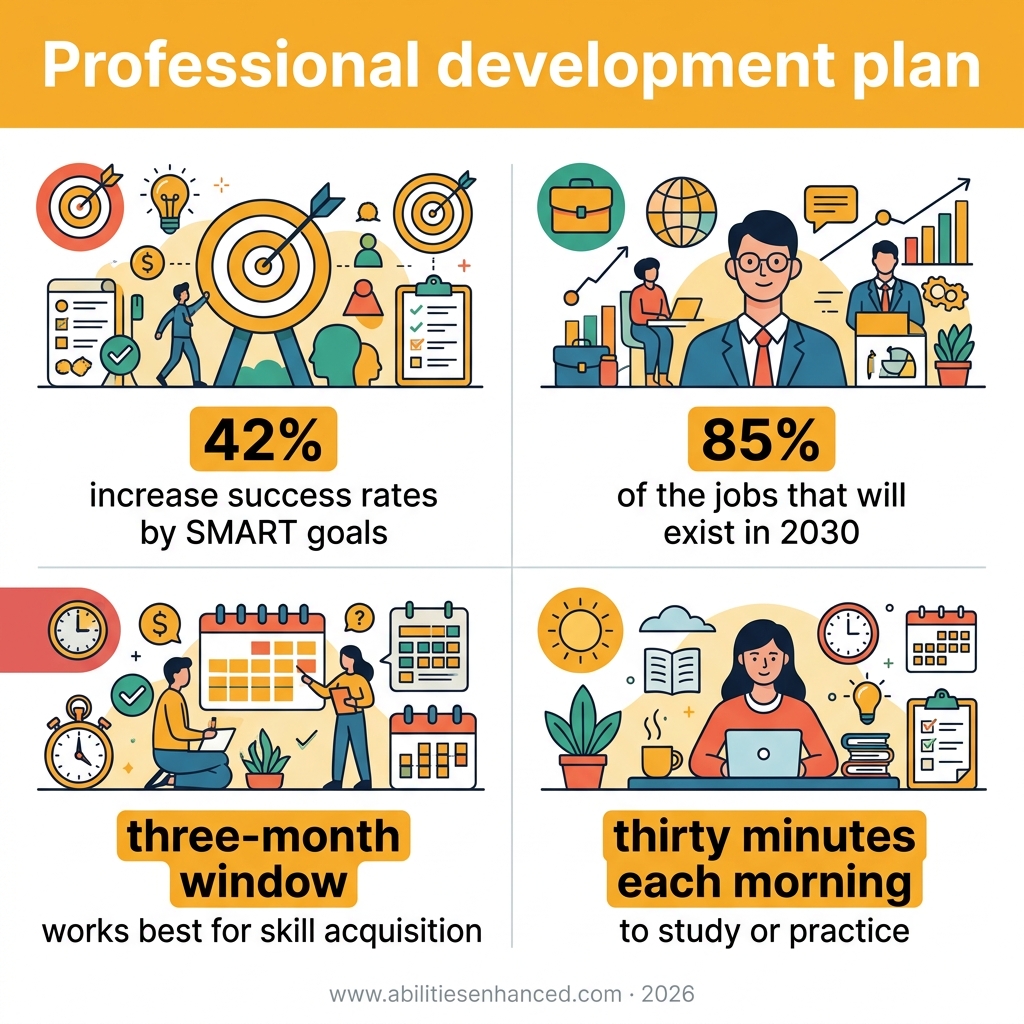
Key takeaway: A Professional Development Plan is your proactive roadmap to career mastery, distinct from retrospective performance reviews. By setting SMART goals, which research suggests can significantly increase success rates compared to vague or unstructured objectives, and conducting skill-gap audits, you take full ownership of your growth. Integrate technical certifications with mentorship to bridge the gap between your current role and future leadership aspirations effectively!
Many professionals wait for their annual review to discuss career growth, even though more frequent conversations accelerate progress. Meanwhile, a significant share of jobs that will exist in 2030 will differ from many of today’s roles as technology reshapes entire industries. You feel stuck in a repetitive cycle, watching colleagues climb the ladder while your own trajectory remains flat and uncertain. You are drifting without a clear roadmap for your future.
It is time to take control of your career trajectory with a robust professional development plan. I will show you how to audit your skills and set SMART goals to secure the promotion you deserve. Let’s build your path to leadership together!
Build Your Professional Development Plan for Career Growth
A professional development plan (PDP) structures career growth through SMART goals, skill-gap analysis, and quarterly audits. Successful plans integrate technical certifications with soft skill mastery, leveraging mentorship to align personal aspirations with current market demands and organizational needs.
Transitioning from a reactive job search to a strategic growth trajectory requires a deep dive into your own professional DNA.
Uncover Your Professional Values and Current Competencies
Use assessment tools like the Big Five or DISC to map your personality. These frameworks reveal how you handle pressure and collaborate. They provide a baseline for your behavioral growth.
Document your technical stack and soft skill strengths clearly. List every software proficiency and leadership experience you possess. Identify the core values that truly drive your job satisfaction. This clarity prevents you from chasing roles that eventually lead to professional burnout.
- Big Five personality traits
- DISC profile categories
- Technical skills inventory
- Core professional values
Once you have mastered your internal landscape, you must distinguish your personal roadmap from corporate evaluation cycles.
Distinguish Your Growth Plan from Standard Performance Reviews
Performance reviews usually focus on past mistakes or company metrics. In contrast, a development plan looks forward. It prioritizes your long-term career trajectory over immediate departmental quotas or quarterly targets.
You must own your professional evolution entirely. Managers facilitate growth, but you direct the path. Self-directed management ensures your skills remain portable across different industries or future leadership roles.
| Feature | Performance Review | Professional Development Plan |
|---|---|---|
| Focus | Past | Future |
| Ownership | Manager | Employee |
| Timeline | Annual | Continuous |
| Primary Goal | Compliance | Growth |
3 Steps to Set Goals That Actually Move the Needle
Establishing your values is just the start; now you must translate those insights into concrete, actionable targets.
Apply the SMART Framework to Your Career Milestones
Vague aspirations like « getting better at management » fail quickly. You need specific and measurable targets to track real progress. Define exactly what success looks like for each objective. Use clear metrics for non-technical areas like public speaking or team conflict resolution.
Set realistic timelines for your short-term and long-term milestones. A three-month window works best for skill acquisition. Longer objectives require yearly checkpoints to ensure you stay on the right track. This rhythmic approach prevents burnout!
Follow this proven structure for every professional development plan goal:
- Specific: define the result
- Measurable: identify the metric
- Achievable: verify resources
- Relevant: align with values
- Time-bound: set a deadline
Connect Individual Aspirations with Organizational Needs
Research your current business objectives to find natural overlaps. Position your new skill acquisition as a direct value-add for your employer. This strategy often secures company funding for your training. It makes your growth indispensable to the organization’s success.
Balance your personal interests with current market demand. Staying relevant requires monitoring industry shifts constantly. Don’t learn obsolete technologies just because they feel comfortable or familiar to your current workflow. Adaptability is your greatest asset!
Focus on high-demand soft skills like emotional intelligence. These competencies bridge the gap between technical expertise and senior leadership. They remain valuable even if you decide to pivot industries later. Invest in your EQ today!
How Do You Bridge the Gap Between Current Skills and Future Roles?
Once your goals are locked in, you need a tactical roadmap to acquire the specific expertise required for your next move.
Select High-Impact Training and Certifications
Identify certifications that carry significant weight in your target industry. Avoid generic courses that offer little market value. Prioritize learning based on your immediate skill-gap analysis results.
Integrate continuous learning into your daily schedule carefully. Dedicate thirty minutes each morning to study or practice. This consistency prevents burnout while ensuring steady progress. Small, daily efforts compound into significant professional advantages over several months of dedicated work.
Evaluate the return on investment for every training program. High-impact choices often involve hands-on projects or recognized credentials. Don’t just collect digital badges; focus on applying new knowledge immediately.
Use Mentorship and Networking to Accelerate Progress
Find mentors who have already reached your target milestones. Their experience provides a shortcut through common industry pitfalls. Ask for specific feedback on your current development strategies and goals.
Leverage your professional network to find hidden development opportunities. Many growth roles never reach public job boards. Create feedback loops with peers to validate your new skills. Real-world application is the only way to prove you have mastered a competency.
Focus on these high-leverage activities to strengthen your professional development plan and gain real-world insights:
- Informational interviews with seniors
- Peer-to-peer skill sharing
- Industry-specific networking events
- Formal mentorship programs within the company
Stay on Track and Pivot When the Market Shifts
Execution is vital, but maintaining momentum requires regular reflection and transparent communication with your leadership.
Audit Your Progress Through Scheduled Self-Reflection
Set up quarterly review intervals to evaluate your goal attainment. Be honest about where you fell short. Adjust your strategies based on changing industry trends or new interests.
Celebrate small wins to maintain motivation during long transitions. Completing a difficult module is a victory. These milestones keep your energy high when the final goal feels distant. Constant self-reflection prevents you from following a path that no longer fits.
Document every adjustment you make to the plan. Tracking your evolution helps you understand your professional patterns. Use these insights to refine your next set of SMART objectives.
Share Your Development Roadmap with Your Manager
Present your growth objectives during one-on-one meetings effectively. Show how your development benefits the team. Request specific resources or stretch assignments that align with your personal roadmap.
Document soft skill improvements alongside technical achievements for maximum visibility. Quantify your leadership growth whenever possible. This evidence is vital during salary negotiations or promotion cycles. It proves you are actively preparing for the next level of responsibility.
Keep the conversation with your manager collaborative and open. Transparency builds trust and opens doors to new projects. Ensure they understand your long-term vision to avoid being pigeonholed. A shared roadmap creates a powerful partnership for your career advancement.
Master your future by aligning SMART goals with a rigorous skill-gap analysis and strategic mentorship. Start your professional development plan today to transform your career trajectory and secure your competitive edge. Own your evolution and turn your boldest aspirations into measurable professional success right now!
FAQ
What exactly is a professional development plan?
A professional development plan (PDP) is your personal, high-impact roadmap for career evolution! It is a dynamic document that allows you to assess your current competencies, define ambitious career goals, and execute specific strategies to reach them. Think of it as your essential tool for staying ahead in a constantly shifting professional landscape!
By using a PDP, you transform vague aspirations into a structured reality. It forces you to identify your strengths and align your personal vision with actionable steps, ensuring you are always moving toward your highest potential.
How do I start building my own growth roadmap?
Start with a deep dive into self-assessment! Use powerful frameworks like the Big Five, DISC, or Myers-Briggs to map out your personality and professional values. You must understand your baseline before you can build your future. Once you know where you stand, define your objectives using the SMART framework to ensure every goal is Specific, Measurable, Achievable, Relevant, and Time-bound!
After setting your targets, identify the concrete resources you need, such as certifications, mentors, or industry workshops. Create a clear timeline with weekly or quarterly checkpoints to maintain your momentum and celebrate your wins along the way!
What is the difference between a PDP and a performance review?
Don’t confuse the two! A performance review is a retrospective process, usually managed by your employer to judge your past results and compliance with company metrics. In contrast, a professional development plan is a proactive, forward-looking strategy that you own entirely! While a review looks at where you were, a PDP focuses on where you are going.
Your PDP is about long-term personal growth and skill acquisition that stays with you regardless of your current role. It empowers you to direct your own path, ensuring your evolution is driven by your aspirations rather than just departmental quotas!
How can I use SMART goals to accelerate my career?
Stop setting vague goals and start using the SMART framework! This system ensures your objectives are laser-focused and trackable. For example, instead of saying « I want to lead, » set a goal to « obtain a PMP certification within a realistic timeframe that takes into account experience prerequisites and several months of exam preparation. » This creates immediate urgency and a clear path to success!
Break your journey down into short-term wins (less than 12 months) and long-term milestones (1 to 5 years). Short-term goals build the necessary momentum and bridge skill gaps, while long-term goals define your ultimate destination, such as reaching a senior leadership position or pivoting to a new industry.
Why is mentorship so important for my professional growth?
Mentorship is a massive career accelerator! Research shows that individuals with mentors tend to benefit from better career progression prospects than those without, according to certaines études sur le mentorat, même si l’ampleur exacte de l’effet varie A mentor provides you with real-world perspectives, critical feedback, and a shortcut through common industry pitfalls that you simply cannot find in a textbook.
By engaging in mentorship, you gain a powerful accountability partner who helps you navigate complex career paths and builds your confidence. It is one of the most effective ways to increase your visibility and secure your place in high-level professional networks!
How often should I update my development plan?
Your PDP is a living document, not a « set it and forget it » task! You must audit your progress through scheduled self-reflection every quarter. This allows you to adjust your strategies based on new market demands, emerging technologies, or shifts in your personal interests.
Regular updates ensure your plan remains relevant and ambitious. Document every adjustment and celebrate your small victories to keep your energy high. Constant refinement is the secret to staying indispensable and achieving long-term professional mastery!
Commentaires récents