

The essential takeaway: career fulfillment stems from aligning professional roles with innate personality preferences rather than just skills. By matching your MBTI profile—like Sensing for precision or Intuition for innovation—you optimize energy and reduce burnout. Remember: 16 distinct personality types offer a roadmap to transform workplace friction into synergy and long-term engagement!
Professional teams with diverse personality types consistently outperform homogeneous groups in innovation and risk detection. A myers briggs career assessment test aligns your innate temperament with the right role, directly boosting daily job satisfaction. This guide shows you how to leverage these insights and transform potential workplace friction into a competitive advantage for your long-term growth.
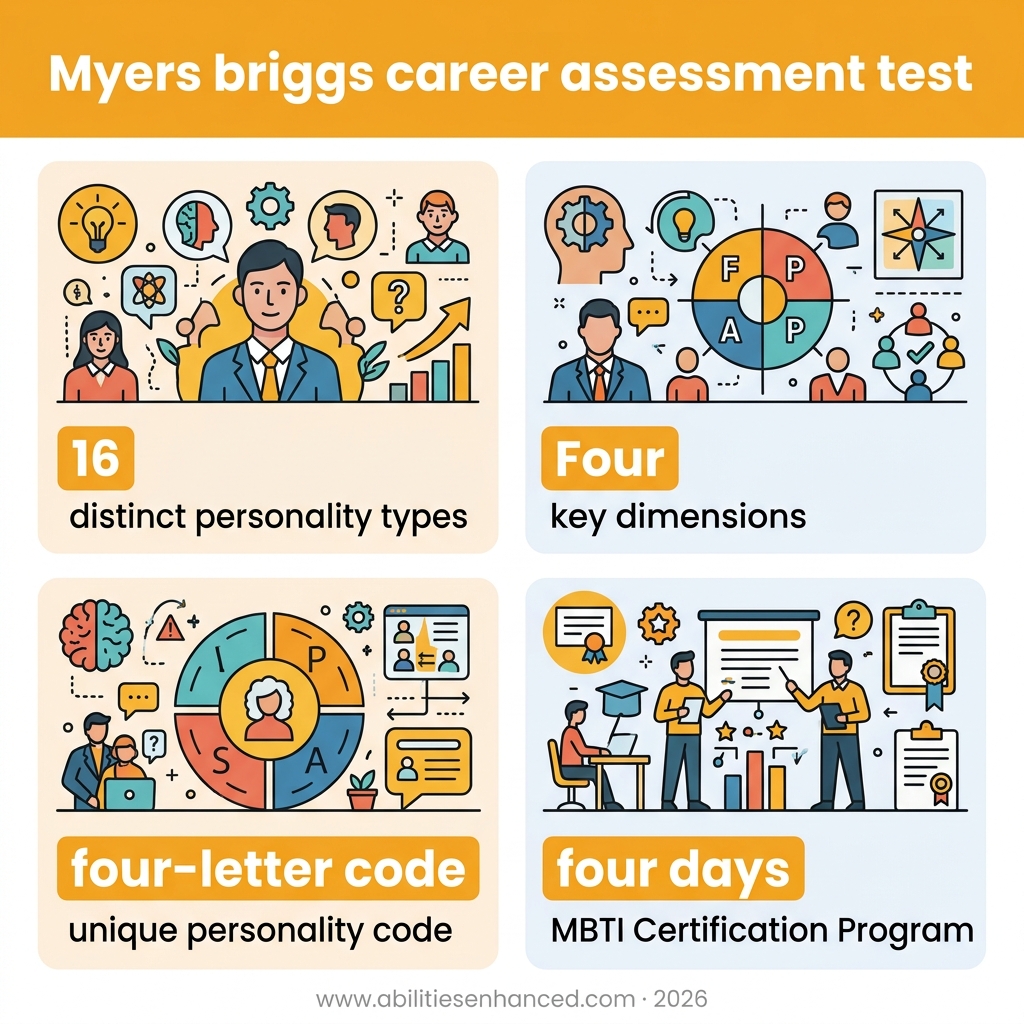
Beyond Four Letters: Why Personality Preferences Dictate Job Satisfaction
Career happiness isn’t just about your paycheck; it’s about how daily tasks align with your internal wiring. When work clashes with your temperament, even a great title feels heavy. Using a myers briggs career assessment test helps bridge the gap between ambition and execution.
The Energy Exchange: Introversion vs. Extroversion in the Office
Extroverts gain energy from open offices and constant collaboration. Contrast this with introverts who need quiet spaces to focus. Ignoring these basic needs leads to rapid daily exhaustion for any professional.
Productivity levels vary based on social interaction. Some thrive in meetings while others produce their best work alone. It is about finding the right balance for your internal battery.
Choose an environment that respects your natural social rhythm. Don’t force a square peg into a round hole. Your career longevity depends on this alignment!
Processing Reality: Sensing and Intuition at the Decision Table
Sensing types are data-driven professionals who love concrete facts. They excel in roles requiring precision and immediate results. They keep the company grounded in reality.
Intuitive types are big-picture thinkers. They prefer theoretical challenges and future possibilities over routine tasks. These individuals often drive innovation and long-term strategy within a team.
A mismatch here causes friction during meetings. Understanding these differences helps in selecting a role that values your specific cognitive approach. It is more than optics; it is a necessity.
The 16 Types: Targeted Career Paths for Every Profile
These specific traits translate into high-performance roles within the modern workforce. Each of the 16 personality types brings distinct strengths to different professional environments.
Analysts and Diplomats: High-Impact Roles for Visionaries
Analysts thrive on solving complex puzzles. These objective thinkers dominate in software development and strategic consulting. Their logical mindset is a massive asset in technical environments. They turn abstract problems into functional systems.
Diplomats prioritize meaning and social harmony. They excel in counseling, non-profits, or creative writing. Their drive to inspire others makes them natural leaders for social change. They bridge the gap between human needs and organizational goals.
- INTJ: Systems Architect
- ENFP: Marketing Creative
- INFJ: Corporate Coach
- ENTJ: Executive Leader
Sentinels and Explorers: Stability and Action in the Modern Market
Sentinels act as an organization’s backbone. They value order and reliability above all. Careers in law or finance suit their meticulous nature. They ensure the gears of industry keep turning without friction.
Explorers crave immediate action and variety. They are indispensable in crisis management or the arts. These profiles need fast feedback to stay engaged. They solve problems in real-time with hands-on expertise.
| Type Cluster | Primary Strength | Recommended Industry | Workplace Need |
|---|---|---|---|
| Analysts | Logic | Tech | Autonomy |
| Diplomats | Empathy | Healthcare | Meaning |
| Sentinels | Reliability | Finance | Structure |
| Explorers | Adaptability | Emergency Services | Action |
Identifying your fit through a myers briggs career assessment test is more than a self-discovery exercise; it is a non-negotiable step for any professional serious about long-term growth. Stop guessing and start aligning your career with your hardwired strengths!
Practical Tactics: Using Your MBTI Results to Land the Next Role
Now that you know where you belong, let’s talk about how to actually get your foot in the door using your personality as a tool.
Resume Refinement: Highlighting Natural Strengths over Learned Skills
Differentiate between what you can do and who you are. Skills can be taught, but temperament is innate. Your resume should reflect your natural approach to challenges and teamwork.
Translate traits into results. Instead of saying you are « organized, » describe how your J-preference helped you manage three simultaneous projects. Use active verbs that align with your type’s specific strengths.
This approach makes you stand out to recruiters. It shows self-awareness and authenticity. Employers hire people, not just a list of software proficiencies.
Interview Mastery: Tailoring Your Communication Style to the Hiring Manager
Observe the interviewer’s style immediately. Adapting your delivery to match theirs creates instant rapport and reduces friction.
Prepare stories that demonstrate growth. If you are a P-type, explain how you developed systems to stay on track. This shows you understand your potential weaknesses and manage them.
- Mirroring body language
- Adjusting speech tempo
- Using « Think » vs « Feel » language
- Asking type-relevant questions
Sustaining Momentum: Managing Stress and Team Dynamics
Landing the job is just the start; staying healthy and productive requires ongoing awareness of your personality’s limits.
Burnout Prevention: Recognizing When a Role Demands Too Much Stretch
« Stretch » is normal, but constant « over-stretch » leads to burnout. If an introvert spends eight hours in back-to-back meetings, they will eventually crash. Recognize these signs early.
Look for physical and emotional symptoms of mismatch. Are you unusually irritable or chronically tired? This often happens when your job forces you to act against your natural grain for too long.
Suggest small daily adjustments. Block out « quiet time » if you are an introvert. If you are a Perceiving type, allow yourself some flexibility within your rigid schedule.
Team Synergy: Resolving Conflict through Type Awareness
Most office conflicts are just personality clashes in disguise. A Thinking type might seem blunt, while a Feeling type might seem overly sensitive. Neither is wrong; they just communicate differently.
Use type dynamics to solve problems faster. Diverse teams bring different perspectives to the table. This variety prevents groupthink and leads to more robust, well-rounded solutions for the company.
To bridge the gap effectively, follow these strategic steps during your next myers briggs career assessment test review or team session:
- Identify the preference gap
- Acknowledge the other person’s perspective
- Adopt a middle-ground communication style
Your myers briggs career assessment test results unlock professional alignment by syncing your cognitive style with the right role. This eliminates burnout and unlocks peak productivity. The next step: apply these insights to negotiate for environments that honor your natural preferences—because sustainable success requires more than just landing a job; it demands building a career that energizes rather than depletes you!
FAQ
What is the Myers-Briggs career assessment test and how does it work?
The Myers-Briggs Type Indicator (MBTI) is a powerful personality assessment tool designed to evaluate your psychological preferences. It measures how you perceive the world and make decisions across four key dimensions: Extraversion vs. Introversion, Sensing vs. Intuition, Thinking vs. Feeling, and Judging vs. Perceiving.
By identifying your unique four-letter code, the assessment provides deep insights into your professional behavior. It helps you understand your communication style, how you manage stress, and your natural approach to conflict resolution. Ultimately, it serves as a roadmap for personal and professional development, ensuring your career path aligns with your internal wiring!
Which assessment is best for defining a specific career direction?
While the MBTI is excellent for self-awareness, the Strong Interest Inventory is the gold standard for choosing a specific career path. This assessment focuses on your interests rather than just your personality traits, helping you identify a fulfilling direction based on what you actually enjoy doing. It is an essential tool for students and mid-career professionals looking for a meaningful change.
The Myers-Briggs Company also offers other specialized tools like the FIRO for interpersonal needs, the TKI for conflict management, and the CPI for leadership development. Combining these assessments creates a comprehensive profile that transforms your professional potential into a competitive advantage!
How can MBTI results help me find a job that actually fits?
Your MBTI results allow you to target environments where you will naturally thrive. For instance, Introverts often find higher satisfaction in private offices or quiet zones, while Extraverts gain energy from collaborative, open-space environments. Understanding your preference for Sensing or Intuition also dictates whether you’ll excel in data-driven, structured roles or big-picture, visionary positions.
Beyond the environment, you can use your results to refine your resume by highlighting innate strengths over mere learned skills. Mentioning how your « Judging » preference helps you manage complex projects or how your « Feeling » trait fosters team harmony makes you stand out as a self-aware and authentic candidate. Don’t just find a job—find your perfect fit!
Can I get certified to use these personality tests professionally?
Absolutely! The Myers-Briggs Company provides professional certifications that empower you to administer these assessments within your own organization or coaching practice. These certifications cover the MBTI, TKI, FIRO, and CPI, giving you the expertise to help others improve their communication, navigate difficult situations, and develop into strong leaders.
Becoming certified allows you to customize development plans and foster team synergy by resolving personality-based conflicts. It is a proven way to drive growth within your professional community and help teams turn friction into breakthroughs!
Commentaires récents