

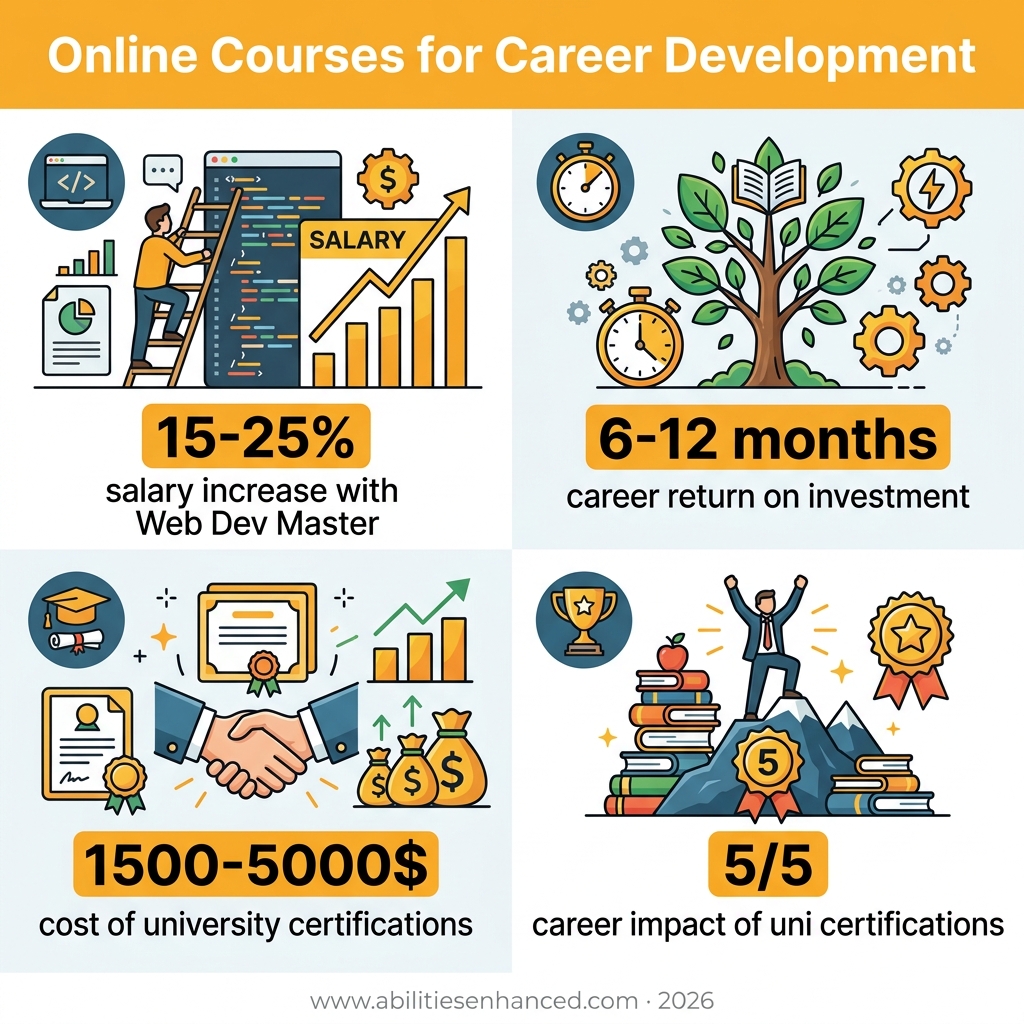
The essential takeaway: High-ROI career development requires prioritizing accredited certifications over vanity badges to secure a real salary bump. Strategic learning pays off fast, as most professionals see a measurable return within six to twelve months. Remember: a Master’s degree in web development can boost your annual earnings by 15% to 25% compared to a bachelor’s degree alone.
Are you tired of seeing your peers land promotions while your hard work goes unnoticed? Choosing the right online courses for career development is your shortcut to gaining the industry recognition and salary leverage you deserve. I will show you how to filter for high-ROI learning and master the emotional intelligence needed to navigate your next strategic pivot with total confidence.
Career Development Courses: Filtering for High-ROI Learning
Most online courses end up as digital paperweights unless they actually move the needle on your paycheck or job title. You need a strategy to separate the noise from the signal.
Validating Industry Recognition and Credibility
Don’t fall for « vanity certificates » that look great on LinkedIn but mean zero to recruiters. Always check if the issuer is an accredited, independent institution before hitting buy.
Established platforms like Coursera carry more employer brand weight than obscure sites. Look for accreditation from recognized bodies to ensure your new skills actually hold market value.
Ask a mentor. Which certifications do they actually respect? Their answer saves you weeks of wasted effort.
Measuring the ROI on Promotion Potential
Think of online courses for career development as a financial investment, not a hobby. Mastering « The Art of Managing Up » creates the salary bump and negotiation leverage you need.
Timing matters for your return. Most professionals see a tangible career shift within six to twelve months after finishing their program.
| Course Type | Average Cost | Time Commitment | Career Impact Score |
|---|---|---|---|
| University Cert | $1,500 – $5,000 | 10-15 hours/week | 5/5 |
| Industry Badge (AWS/PMP) | $150 – $600 | 5-8 hours/week | 4.5/5 |
| Skill-based (Excel/SQL) | $10 – $200 | 3-5 hours/week | 3.5/5 |
| Soft Skills Workshop | $50 – $300 | 2-4 hours/week | 4/5 |
Managing Up: Influence Your Leadership with Integrity
Moving from external training to internal dynamics, let’s talk about the most important relationship you have: the one with your boss.
Aligning with Your Boss’s Goals
To identify what keeps your manager up at night, analyze their core pressures. You must bridge the gap between your daily tasks and their highest priorities. Solving their problems effectively solves your own.
Success requires constant strategic alignment with the department’s primary objectives. Every project you tackle should directly reflect these top-tier goals. This proactive approach transforms you from a reactive employee into a partner.
Communicating Wins Without Bragging
Frame your individual achievements as team wins or critical project milestones. This technique highlights progress while building a powerful professional presence. You demonstrate value without the friction.
Send a weekly snippet email summarizing key results and next steps. It keeps you on their radar constantly. This brief update provides visibility without the heavy burden of a long meeting.
New Manager Toolkit: Strategies for a Winning First 100 Days
Managing up is half the battle; the other half is leading the people who now report to you.
Building Trust with Your Direct Reports
Focus on listening more than talking during your first month. Genuine trust is built through active listening and empathy. Prioritizing their perspective establishes your leadership foundation.
Schedule one-on-ones immediately. Show your team you value their time and professional input right away.
- Ask about career goals
- Identify current roadblocks
- Clarify preferred communication styles
- Set a recurring meeting cadence
Setting Clear Expectations and Boundaries
Define what success looks like for the team. Be specific about deadlines and quality standards. I believe accountability and clear boundaries are the non-negotiables for high performance. You must lead with total transparency from day one.
Avoid micromanagement at all costs. Give them the « what » and let them figure out the « how. »
If you want to sharpen these leadership skills further, exploring specialized online courses for career development can provide the structured toolkit you need to excel in this transition.
Emotional Intelligence: Mastering the Yale Leadership Framework
But even the best toolkit fails if you can’t control your own reactions when things get messy.
The RULER Approach to Workplace Dynamics
The Yale RULER acronym simplifies emotional intelligence into five actionable steps. It involves Recognizing, Understanding, Labeling, Expressing, and Regulating emotions. This framework transforms how you handle professional interactions daily.
Mastering these specific skills empowers your leadership through:
- Recognizing: spotting cues in others
- Understanding: finding the cause of a feeling
- Labeling: using precise vocabulary
- Expressing: communicating appropriately
- Regulating: managing the response
Regulating Emotions Under High Pressure
Try the « pause » technique during intense moments. Before reacting to a heated email, take ten minutes. This emotional regulation prevents career-limiting moves. It shifts your mindset from reactive to strategic. You stay in control.
Focus on long-term resilience to stand out. High EQ leaders stay calm while everyone else is panicking. This stability builds immense professional credibility. While others lose focus, you lead with clarity. Investing in online courses for career development can further sharpen these vital interpersonal skills.
Career Self-Management: Mapping Strategic Pivots with Design Thinking
Once you have your emotions in check, you can start designing your next big move with logic.
Prototyping Your Next Career Move
Test your professional hypotheses before committing fully. Avoid quitting your current role immediately. Instead, tackle a small project or secure a shadowing opportunity to observe daily realities firsthand.
Apply design thinking to challenge your assumptions. Does that specific industry actually align with your goals?
Conduct three informational interviews. Focus on the daily grind rather than just the highlights.
Iterating Based on Real-World Feedback
Analyze your prototype results and pivot. You might discover a need for specific certifications or online courses for career development. Use strategic pivots to adjust your trajectory based on these concrete findings.
View failure as essential data. Use it to refine your career map and launch your next iteration.
Professional Presence: Mastering Global Business Communication
Finally, your plan only works if you can communicate it clearly across cultures and time zones.
Adapting Style for International Teams
Communication styles vary deeply across borders. Low-context cultures prioritize direct, explicit verbal messages. Conversely, high-context environments rely on subtlety and relationship building to convey meaning effectively.
Clarity is your best asset. Avoid slang and local idioms during global meetings. Keep your Business English simple and professional to avoid costly misunderstandings with international partners.
Executive Presence in Virtual Environments
Master the digital room immediately. Eye contact with the camera is the new handshake. These habits define your virtual leadership and prove your digital literacy in a remote world.
Projecting authority requires the right setup. Use these technical essentials to stay sharp:
- Invest in a high-quality microphone
- Use a neutral professional background
- Master the ‘mute’ button
- Engage participants with direct questions
Ready to level up? Exploring targeted online courses for career development can bridge the gap between your current skills and executive-level influence.
Select accredited certifications over vanity badges to ensure a high ROI for career development courses. Apply these new skills to manage up with integrity and lead your team using the RULER framework. Start today to unlock your promotion potential and design a future of professional excellence!
FAQ
How can I distinguish between a valuable certification and a « vanity » certificate?
To avoid digital paperweights, you must look for accredited institutions and recognized industry bodies. Recruiters on platforms like LinkedIn prioritize certifications that require rigorous assessments, exams, or proven professional experience rather than those that are merely decorative.
A high-ROI course isn’t just about a badge; it’s about employer brand recognition. Before enrolling, I suggest you ask a mentor which specific credentials they actually respect in the hiring room to ensure your investment moves the needle on your career.
What is the expected ROI for online career development courses?
Think of professional training as a strategic investment, not a hobby. Effective programs can generate a salary bump or organizational ROI ranging from 25% to 300%. For every dollar spent, you could see a return of $1.25 to $4 in increased productivity or negotiation leverage.
Most professionals begin to see a tangible return on their investment within six to twelve months after completion. By quantifying benefits like time saved or errors reduced, you transform a simple course into a powerful asset for your next performance review.
How can I effectively manage my relationship with my boss?
The secret to « Managing Up » is strategic alignment. You need to identify exactly what keeps your manager up at night and position yourself as the solution to those problems. When you solve their headaches, you naturally accelerate your own career progression.
I recommend sharing your wins without sounding arrogant by framing them as « team wins. » A quick weekly « snippet » email is a fantastic way to stay on their radar and build your professional presence without demanding more of their limited time.
What are the first steps for a new manager to build team trust?
In your first 30 days, focus on listening more than talking. Building trust requires active listening and genuine empathy to understand your team’s current dynamics. Schedule one-on-one meetings immediately to show your direct reports that you truly value their input and time.
During these initial sessions, I recommend you focus on:
- Asking about their long-term career goals.
- Identifying current roadblocks holding them back.
- Clarifying their preferred communication styles.
- Setting a recurring meeting cadence.
How does the Yale RULER framework improve leadership?
The RULER approach is a game-changer for emotional regulation in high-pressure environments. It stands for Recognizing, Understanding, Labeling, Expressing, and Regulating emotions. Mastering these steps allows you to stay calm and lead effectively while others might panic.
By using tools like the « Meta-Moment, » you learn to pause before reacting to a heated situation. This prevents career-limiting moves and builds long-term resilience, making you a more stable and influential leader within your organization.
How can I use Design Thinking to pivot my career?
Stop guessing and start « prototyping » your next move. Before quitting your job, test your assumptions through a shadowing opportunity or a small side project. This design thinking approach allows you to gather real-world data without the risk.
I encourage you to conduct informational interviews to learn about the daily grind of a new role. Use that feedback to make strategic pivots in your learning path, ensuring your career map is always based on reality rather than just theory.
How do I maintain executive presence in a virtual setting?
Mastering the digital room is the new handshake. You must treat eye contact with the camera as a vital tool for virtual leadership. Simple adjustments to your digital literacy, like choosing a professional background, can significantly boost your perceived authority during global calls.
To ensure your presence is felt in every meeting, I suggest you:
- Invest in a high-quality microphone for clear audio.
- Use a neutral, professional background.
- Master the ‘mute’ button to avoid distractions.
- Engage participants directly with specific questions.
Commentaires récents