

Key takeaway: Master physical logic and spatial reasoning to dominate your mechanical aptitude test. These assessments prioritize innate intuition over academic history, using high-pressure, 30-minute drills to predict your technical success. By mastering pulleys, gears, and Ohm’s Law, you prove your diagnostic potential. Remember, scoring at or above the 80th percentile significantly boosts your hiring prospects for elite technical roles.
Success in technical fields often hinges on a single hurdle: the mechanical aptitude assessment test. With top firms using these timed evaluations to screen large applicant pools, your ability to solve complex problems within a strict time limit can determine your professional trajectory. You might feel the pressure of competing against high percentile rankings while facing strict bans on calculators and external references.
I will help you master the physical laws and spatial logic required to dominate these exams. We are going to break down everything from Ohm’s Law to gear rotations so you can walk into your assessment with absolute certainty.
Master the Mechanical Aptitude Test Basics
Mechanical aptitude tests evaluate innate physical logic through multiple-choice questions on pulleys, gears, and circuits. Scoring relies on percentile rankings compared to norm groups, directly influencing hiring for technical roles and military placements.
Understanding these core evaluation methods is your first step toward securing that high-stakes technical position you deserve.
Evaluate Your Technical Reasoning Potential
The mechanical aptitude assessment test acts as a powerful gauge for your innate physical logic. It intentionally bypasses your academic history to uncover raw talent. We focus on your spatial skills.
Modern employers utilize these specific metrics to make informed hiring decisions. They need to predict your performance in high-stakes technical environments before committing to costly on-the-job training.
Distinguish between vocational knowledge and pure intuition. One comes from books, but the other is a gut feeling for machines. This is mechanical foresight. Tests target this unteachable spark within you.
Navigate Common Test Formats and Constraints
Get ready for the multiple-choice structure. Most questions appear on a computer screen. Remember, speed is just as vital as accuracy in this high-pressure environment. Stay sharp.
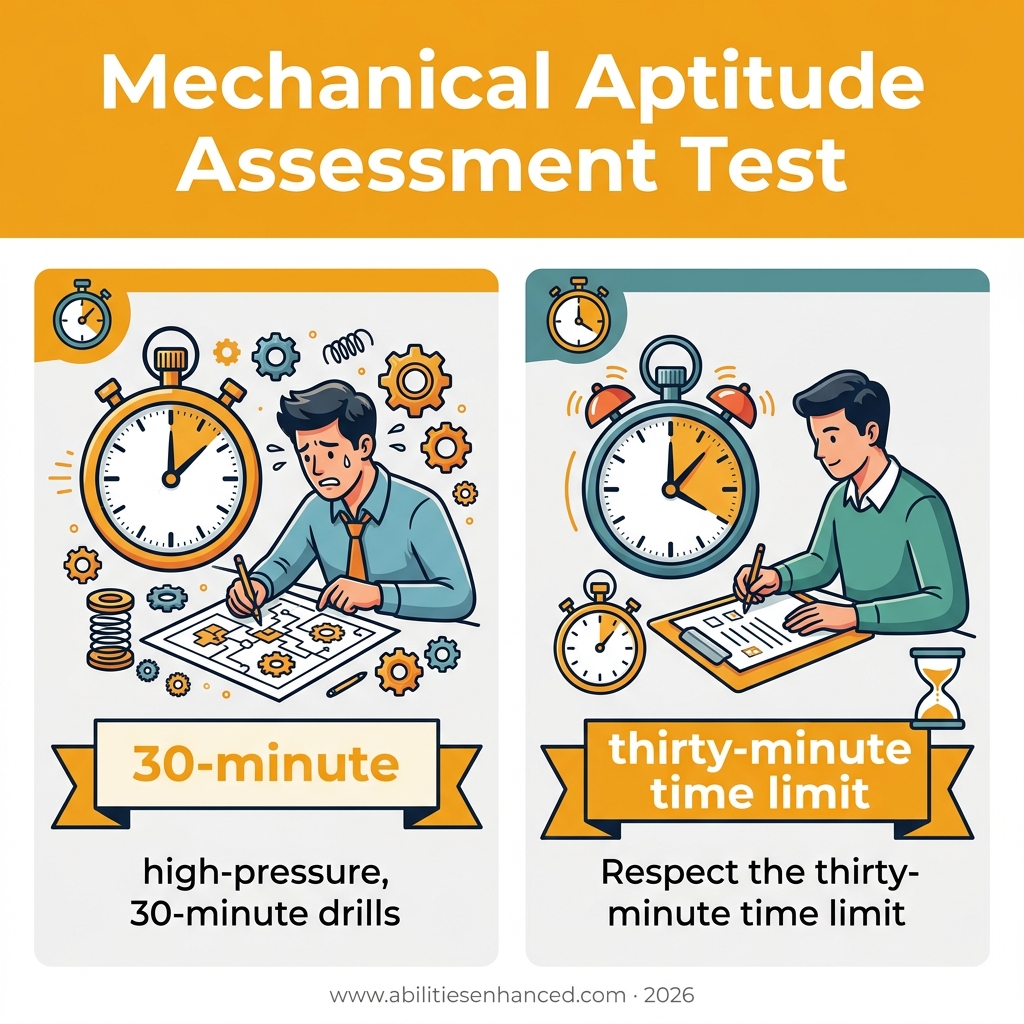
Respect the thirty-minute time limit. This constraint creates immense pressure for every candidate. You must move fast without making silly errors. Every second counts toward your success.
Be aware of the strict ban on calculators. No external references are allowed during your session. You rely solely on your brain and basic scratch paper.
Decipher Physical Principles and Spatial Logic
While understanding the test format is necessary, the real challenge lies in the physical laws governing every question.
Analyze Levers Gears and Hydraulic Systems
Mastering simple machines like pulleys is your first step toward success. You must understand how inclined planes reduce effort by extending distance. These concepts form the core of any mechanical aptitude assessment test.
Industrial performance relies on friction and torque. These specific forces dictate how heavy machinery operates safely. You need to grasp these mechanics to ensure operational integrity in technical roles.
Focus on these high-impact technical areas:
- Mechanical advantage in gears
- Direction of rotation in complex assemblies
- Impact of belt tension
- Hydraulic pressure distribution
Visualize Objects Through Spatial Reasoning
You must sharpen your mental manipulation skills immediately. Practice turning flat 2D drawings into solid 3D mental models. This ability is vital for diagnosing and troubleshooting complex equipment.
Pay close attention to perspective and mirror imaging. This helps you identify hidden components within a structure. Precision is non-negotiable when you visualize these mental shifts during the exam.
Apply proven techniques for pattern recognition. Watch closely as structures unfold or rotate in your mind. Training your eyes now prevents costly confusion when the timer starts ticking.
Tackle Electronics and Practical Shop Math
Moving beyond pure mechanics, you must also master the invisible flow of electricity and the math that supports it.
Simplify Circuit Theory and Electrical Flow
Master series and parallel circuits. Series setups force current through one path, while parallel paths split it. This distinction is a frequent test topic.
Apply Ohm’s Law to solve problems. Calculate voltage or resistance by multiplying current and resistance values. You do not need a calculator for these basics.
Identify electrical components and symbols instantly. Recognize resistors and capacitors within complex schematics. Knowing these icons saves precious time during the test.
Solve Mathematical Problems in Technical Contexts
Focus on unit conversions and geometry. These skills are applied to various workshop scenarios. Precision is your ultimate goal here.
| Topic | Practical Application | Key Formula/Concept |
|---|---|---|
| Fractions | Reading precise measurements | Part-to-whole logic |
| Decimals | Calculating tight tolerances | Precision placement |
| Geometry | Determining area or volume | Spatial calculations |
| Ratios | Adjusting gear speeds | Proportional balance |
| Units | Standardizing conversion | Metric vs Imperial |
| Logic | Systematic deduction | Reasoning pathways |
Emphasize logical deduction over complex math. Most problems test your reasoning, not your arithmetic. Trust your technical instincts when numbers look complex.
Execute a High-Performance Preparation Strategy
Knowledge is only half the battle; the rest is about tactical execution on the day of the assessment.
Apply Strategic Test-Taking Techniques
Manage your time per question. Avoid getting stuck on one hard problem. Keep the momentum going to finish everything.
Use a guessing strategy. If there is no penalty, never leave a blank. Pick an answer and move.
Maximize your results by following these high-impact habits during your drills:
- Create a distraction-free practice space
- Use a timer during drills
- Review incorrect answers immediately
- Simulate the actual test environment
Interpret Raw Scores and Percentile Rankings
Understand how raw points convert. Percentile data compares you to other candidates. It shows where you stand in the talent pool.
Consider the impact of safety awareness. Employers prioritize those who recognize hazards. High scores here are non-negotiable.
Address the fear of failure. Retesting is often possible after a waiting period. Use the gap to sharpen your mechanical intuition.
The candidates who score highest on a mechanical aptitude assessment test are rarely the ones who crammed formulas the night before — they are the ones who trained their eyes to read a mechanism the way others read a sentence. Keep that instinct sharp long after the test, and it keeps paying off on the job long after the score report does.
FAQ
What exactly does a mechanical aptitude assessment measure?
These tests are designed to evaluate your innate physical logic and technical reasoning potential. Instead of focusing on your academic history, they gauge your ability to understand fundamental physical principles, spatial relationships, and how machines function in real-world scenarios.
By analyzing your grasp of concepts like levers, gears, and pulleys, employers can predict your performance in high-stakes technical environments. It is all about identifying that specific, unteachable spark for troubleshooting and mechanical foresight!
How are these technical exams typically structured?
You will generally face a multiple-choice format, often delivered via computer. These sessions are strictly timed, sometimes as brief as thirty minutes for dozens of questions, meaning speed and accuracy are both vital for a top-tier result.
Expect a focused environment where calculators and external references are strictly prohibited. You must rely entirely on your brain and basic scratch paper to navigate through the challenges and maintain your momentum!
What specific physics and math topics should I master?
The assessment covers a broad range of physical laws, including friction, torque, and fluid pressure. You need to be comfortable with simple machines, Newton’s laws, and basic electrical circuits, specifically understanding how current flows through series and parallel setups.
Regarding math, the focus is on practical shop math rather than complex calculus. You should be ready to handle unit conversions, basic geometry for area and volume, and logical deductions involving ratios and gear speeds to prove your technical competence.
How can I improve my spatial reasoning skills for the test?
Spatial reasoning involves the ability to mentally manipulate 2D drawings into 3D models. You can sharpen this skill by practicing 3D folding exercises, analyzing mirror images, and identifying patterns in how structures rotate or unfold.
Consistent training allows you to recognize configurations instantly, which is crucial for the timed constraints of the exam. Mastering this visualization will give you a massive advantage when interpreting complex technical schematics!
What do my final scores and percentile rankings actually mean?
Your raw score is converted into a percentile ranking, which compares your performance directly against a norm group of other candidates. This data shows employers exactly where you stand in the talent pool and highlights your potential for long-term technical growth.
Certain employers may place strong emphasis on safety awareness for industrial roles. If you don’t hit your target the first time, don’t panic! Use the waiting period to sharpen your intuition and come back stronger for a retest.
Commentaires récents